Short answer: Zealy, Galxe and Layer3 are all quest platforms, and the sharpest difference between them is not features but whether a participant needs a crypto wallet. Layer3 requires one to sign in. Zealy and Galxe do not. On price, Zealy's entry paid plan is $149 per month, Galxe's is $999, and Layer3 publishes no fiat price at all.
Disclosure: Zealy publishes this comparison and Zealy is one of the three platforms in it. Every published price and quoted claim links to the page it came from, including the competitors' own help centres and docs. Zealy's USDC withdrawal terms are the only figures here with no public page behind them: the $1 minimum was checked in the product on 7 August 2026, and Zealy publishes neither a withdrawal fee nor a daily limit anywhere, so none is quoted. Our Zealy guide explains the payout mechanics in full. The section on where Galxe and Layer3 beat Zealy is sourced the same way.
Last verified: prices and platform facts 7 August 2026; the MCP comparison and Zealy's withdrawal terms rechecked 12 August 2026. Each claim carries its own date where the two differ. Prices and fees change; the links go to the pages that will change with them.
What each platform actually is
Zealy, Galxe and Layer3 all let a project publish tasks and reward the people who complete them, but they serve different audiences. Zealy is a community engagement platform that works without crypto. Galxe is an on-chain credential and distribution network. Layer3 is a consumer app for on-chain activity that projects can advertise inside.
Zealy is run by Freyja Labs and was previously called Crew3. Communities publish quests; members earn XP, Zaps, USDC, Discord roles or a project's own token; leaderboards and time-boxed sprints rank participants. We've written up how the payouts work in detail.
Galxe calls itself "Your Web3 Growth Engine" on galxe.com, and in its documentation "a decentralized super app and web3's largest onchain distribution platform." Quest is one part of a suite that also includes Passport, Score, an identity protocol, and its own Layer 1 blockchain, Gravity. Galxe's Quest docs state it serves "over 22 million users", a self-reported figure.
Layer3 leads with "Discover onchain finance with one app" on layer3.xyz; its documentation describes Layer3 as "where onchain activity becomes rewarding." Members complete Activations, mint CUBEs — credentials recording what they did on-chain — earn XP, and enter competitions ranked on metrics like trading volume, PnL or ROI.
One naming note. "Layer3" here means the quest platform at layer3.xyz. It is unrelated to layer 3 of the OSI networking model, and unrelated to Layer3 TV, the IPTV provider T-Mobile acquired in 2018.
What a project pays
Zealy is the cheapest of the three to start paying for, at $149 per month billed annually against Galxe's $999. Layer3 publishes no fiat price: its cost is an unstated amount of L3 token, staked for twelve months and earning APY, so locked capital rather than spend. Zealy and Galxe have free tiers; Layer3 has none.
| Zealy | Galxe | Layer3 | |
|---|---|---|---|
| Free tier | Yes — "most features, all integrations, and unlimited users", subject to free-plan usage limits | Yes — Basic, no subscription required | No published free tier |
| Entry paid tier | Standard, $149/mo billed annually ($199/mo over 6 months) | Essentials, $999/mo billed annually ($1,166/mo quarterly) | No fiat pricing published |
| Next tier | Plus, $359/mo annually ($549/mo monthly) | Growth, $1,699/mo annually ($1,999/mo quarterly) | — |
| Enterprise | Custom | Custom | — |
| Usage billing | 1 claim credit per quest claim; X tasks cost extra (a like-and-retweet task costs 6) | Flat subscription; no monthly-only plans | Stake L3 on Ethereum for at least 12 months to unlock a Space; the stake earns APY |
| Going over the allowance | $15 per 1,000 credits on Standard, $12 on Plus | Not applicable | Not applicable |
| Optional extra | — | Verified Space Program: 350 USDC or USDT per year | — |
| Publish without approval? | Yes | Yes | No — every Activation is reviewed |
| AI agents / MCP | Yes — 125 tools at mcp.zealy.io/mcp | None documented | None documented |
Sources, all accessed 7 August 2026: Zealy billing and plans and Zealy X task costs; Galxe business overview and Verified Space Program; Layer3 builder docs.
Zealy's headline price is not the whole cost, and it would be dishonest to present it that way here. Claim credits are consumed per claim, X tasks consume several each, and a campaign that runs past its allowance buys more at $15 per 1,000. Galxe's Verified Space fee, meanwhile, is optional — projects run quests without it — so read that row as an upgrade rather than a toll. The gap survives the arithmetic anyway: a Standard month plus 10,000 credits of overage comes to $299, still under a third of Galxe's entry subscription before any campaign runs.
What a member gets
Members receive different things on each platform, and only some of it is money. Zealy pays USDC that Zealy itself holds and distributes, and the member pays nothing to claim it. Galxe rewards are frequently raffles or shared pools, and members pay $0.08 per claim unless the project covers it. Layer3 pays mainly in XP and CUBE credentials, and charges a fee to mint each one.
| Zealy | Galxe | Layer3 | |
|---|---|---|---|
| Wallet needed to sign up? | No — Discord, email or wallet | No — X, Discord, email or Telegram | Yes — wallet only |
| Wallet needed to get paid? | For USDC withdrawal, to a Polygon address (product-checked) | Yes, for any on-chain reward | Yes |
| Does the member pay a fee? | Nothing to claim; USDC withdrawals start at a $1 balance, and Zealy publishes no withdrawal fee or limit (product-checked, not documented) | $0.08 per claim, unless the project makes it gasless | A credential fee per CUBE mint; amount not published |
| Cash-like reward | USDC, "managed and guaranteed by Zealy" | Token rewards, often as raffles or shared pools | Token rewards |
| Non-crypto reward | Discord roles, XP, Zaps | Discord roles, Custom Reward | Perks: gift cards and physical goods, shipped |
| Credential you keep | — | OAT, Galxe Passport | CUBE, an NFT the member owns |
Sources, all accessed 7 August 2026: Zealy rewards; Galxe claim fees, Galxe accounts and Galxe quest rewards; Layer3 platform docs.
The fee row is the one most people miss. Galxe publishes a base claim fee of $0.08 paid by the member, discounted at higher loyalty levels and waived entirely if the project sets the quest to gasless or funds a Gas Station — publishing that number at all is a point in Galxe's favour on transparency. Layer3's equivalent, the CUBE credential fee, is documented only as "small". Zealy has no comparable number because claiming costs the member nothing, which matters most on the campaigns where a $0.08 charge is the reason someone abandons a claim worth a few dollars.
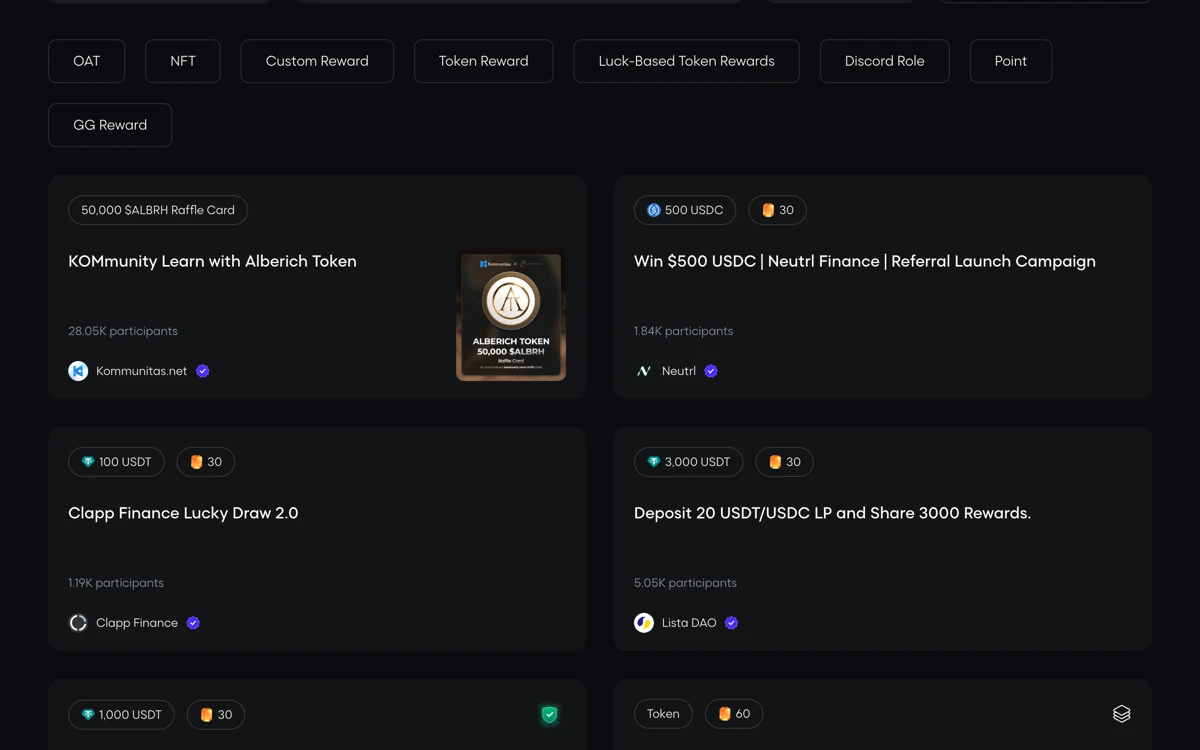
Galxe's public quest explorer at app.galxe.com/quest, captured 7 August 2026.
Read what the Galxe cards say: "Lucky Draw", "Raffle Card", "Deposit 20 USDT/USDC LP and Share 3000 Rewards". Many headline amounts are pools shared across thousands of participants, or raffles with few winners. Galxe is explicit about this in its own docs — its luck-based token reward guarantees every winner "at least $1 worth of tokens" with the remainder allocated randomly — but the number on the card is not what one person receives. Reading the terms behind a headline number is a transferable habit: it is the whole method of our audit of seven crypto gambling sites, where advertised bonuses hide wagering requirements the way raffle pools hide odds.
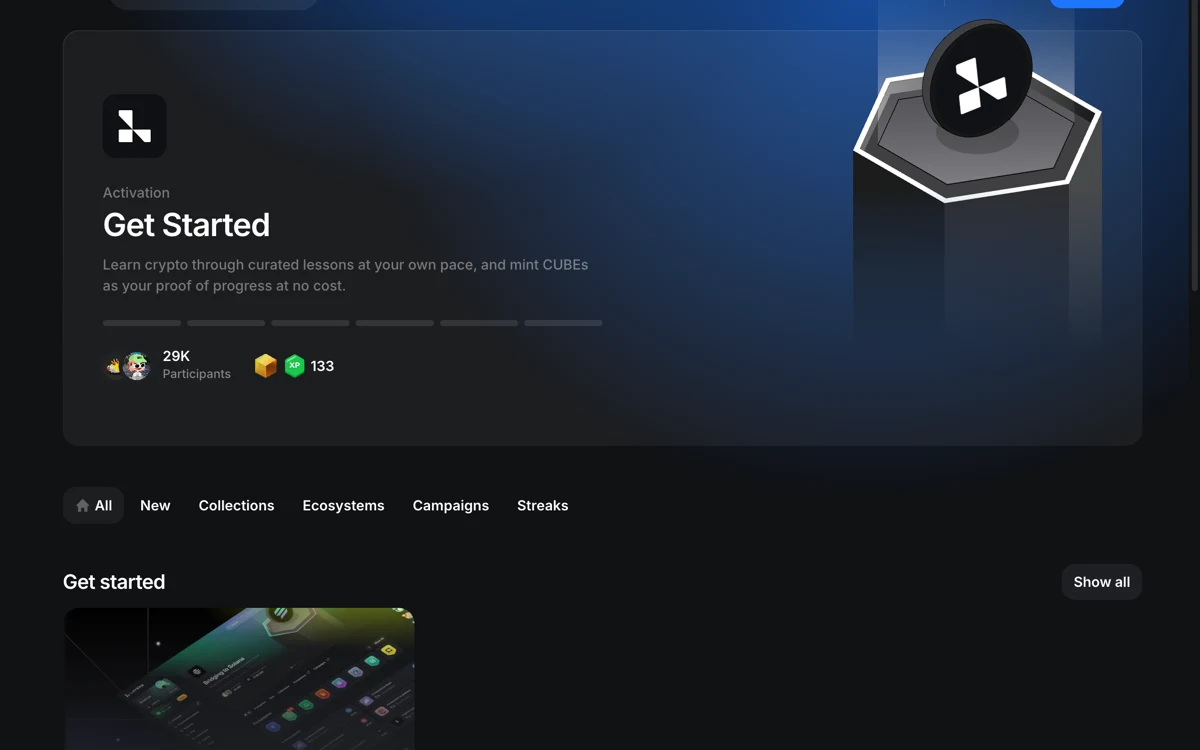
Layer3's discover page at app.layer3.xyz, captured 7 August 2026. The banner advertises free CUBE minting for this specific onboarding activation; Layer3's docs describe a credential fee on CUBE mints generally.
A member's default currency on Layer3 is XP and CUBEs instead of cash. Minting a CUBE costs a credential fee that Layer3's documentation describes only as "small" without stating an amount, and members can earn back "up to 100% of the mint cost depending on your tier".
Where Galxe is better than Zealy
Galxe beats Zealy wherever a campaign depends on what someone has already done on-chain. Its credential system verifies contract interactions, token balances, NFT holdings and governance votes as no-code building blocks, and its X quality gates are configurable settings instead of manual review. Zealy has no equivalent to either.
- On-chain credential verification. Contract queries, wallet balances, NFT holdings and Snapshot voting history are first-class no-code credentials, and custom credentials import from CSV, a Google Sheet on a 12-hour auto-sync, or a REST or GraphQL endpoint (Galxe quest tasks). Galxe is built for this and Zealy is not.
- X quality gates as a product. Minimum account age, minimum follower count and blue-check requirements are settings (same source). Its API-validated X Authentic Verification goes further, though it consumes credits and is limited to higher-level spaces and Galxe Business subscribers.
- Gas handling as a product. On-chain claims cost gas, and Galxe both prices that transparently for the member and gives projects a Gas Station to absorb it in bulk. If your rewards are on-chain, that plumbing is real and Zealy has no equivalent.
- Mystery Box rewards with per-item drop probabilities and a timed on-chain reveal (Galxe quest rewards).
- Its own infrastructure. Gravity, a Layer 1, and a zero-knowledge identity protocol with published SDK tooling. That is a scale of investment Zealy has not made and is not trying to make.
Where Layer3 is better than Zealy
Layer3 beats Zealy on reward fulfilment and on quality control. It ships physical goods and gift cards as a platform product, reviews every campaign before it goes live, and pays campaign creators a share of its own fee. Zealy does none of those three things.
- Perks that aren't crypto at all. Gift cards and "physical goods: real-world rewards, shipped", matched to a member's on-chain history (Layer3 Perks). Zealy's "Other" reward type is a text field the community fulfils itself; Layer3 runs an actual fulfilment layer.
- An editorial gate on every campaign. Layer3's builder docs state: "We may refuse Activations that lack incentives, present poor UX, impose high fees without adequate compensation, or promote unaudited dApps." That is real quality control, and Zealy does not do it.
- It pays campaign creators, and generously. Referring 50 new users is the threshold to become monetised at all; past it, a creator earns fees from every Activation completed by any Layer3 user, not only the ones they referred, with the share rising by tier (creator rewards). Neither Zealy nor Galxe documents paying creators at all.
- Credentials members keep. A CUBE is an NFT the member owns independently of Layer3 — "a unique ERC-721 NFT (EVM) and Compressed NFT (Solana)". Zealy XP exists only inside a Zealy community.
- Competitions on trading metrics — volume, PnL, ROI or another performance measure — instead of task completion. A genuinely different primitive, and better for DeFi campaigns.
- Built-in distribution. Layer3 is a destination app with its own users, so a campaign reaches an existing audience rather than only the one you bring.
On audience size, use the right number. Layer3's homepage shows 3M+ users and its CUBEs documentation says 3.3M+, while its builder-facing page says "250,000+ high-quality monthly transacting users". All are Layer3's own figures, and the last is the one that matters when forecasting a campaign.
Where Zealy is better than Galxe and Layer3
Zealy wins wherever the audience is not already on-chain. Members join with Discord or email and can complete a full campaign — quests, XP, Discord roles, Zaps — without ever touching a wallet, which Layer3 does not permit at all, and without paying anything to claim what they earn. Zealy also reviews subjective work that on-chain verification cannot judge, gives an admin more to configure on a single quest, and costs a fraction of Galxe at the entry tier.
- No wallet required, at any point, to take part. Layer3 requires a wallet to sign in, though Layer3 does offer one-click smart-wallet creation with "no gas, no fees, no extensions" to soften that. For an audience that will not install a wallet or hold crypto at all, Zealy is still the only one of the three that works.
- Discord as a first-class integration. Role rewards, quests gated on roles, server notifications for new quests, pending reviews and sprint endings, and bot commands for admins (Zealy Discord docs). Layer3's action reference documents joining a server and connecting an account, and describes role-gating as a future capability.
- Human review of subjective work. Open-ended submissions route to community reviewers, which platforms built on on-chain verification cannot judge (Zealy quest docs). Zealy's review docs say AI-assisted review starts "with the Plus plan", so it is not on the $149 Standard plan.
- Reward methods built for content campaigns: winners picked by community vote, or ranked by a tweet's views or interactions depending on configuration (Zealy reward methods).
- USDC that Zealy holds and distributes on a successful claim, described in its docs as "managed and guaranteed by Zealy" — a fixed amount to a named person, not a pool split among everyone or a raffle ticket.
- Nothing for the member to pay. No per-claim fee and no mint cost, where Galxe charges $0.08 a claim by default and Layer3 charges an unstated fee per CUBE. On a reward worth a few dollars, that is the difference between a claim completed and a claim abandoned.
- Fewer steps between seeing a quest and being paid. Sign in with Discord, complete the task, claim. No wallet connection, no signature prompt, no gas, no credential to mint. Every step the other two add is a step a member can fail at, and the drop-off lands on the campaign that paid for the traffic.
- More that an admin can actually configure. Task types across X, Telegram, TikTok, tokens, NFTs, partnerships and proof of humanity; five reward methods; engagement thresholds on the X tasks that produce a post; sprints that time-box a leaderboard. Where none of that fits, the API task hands the decision to an endpoint you control: Zealy posts the member's identifiers, and your
200or400settles the claim. - An MCP server, so an AI agent can run the campaign. Zealy publishes 125 tools at
mcp.zealy.io/mcp— an agent can draft quests, publish a sprint, read the leaderboard and clear a review queue without a human in the admin panel. Neither Galxe nor Layer3 documents an equivalent, checked 12 August 2026. - Price at the entry paid tier: $149 per month against $999.
Which should you pick?
If your members already hold wallets and your campaign is about on-chain behaviour, Galxe and Layer3 fit better than Zealy. Choose between them on budget certainty: Galxe publishes prices, Layer3 does not. If your community lives on Discord, or includes people who will never install a wallet, Zealy is the only one they can fully take part in. And if the campaign is about content, engagement thresholds or work that needs a human to judge it, Zealy gives an admin more to configure — and an AI agent something to configure it with — at roughly a seventh of Galxe's entry price.
If you are a member rather than a project, check the reward type before you spend an evening on any of them. On all three platforms, a reward the platform itself delivers and a reward a project has promised to send are very different things.