Short answer: Zealy, at zealy.io, is a platform where communities publish quests — small, checkable tasks — and reward the people who complete them. Zealy's rewards documentation lists six reward types. Only one of them, USDC, is described there as "managed and guaranteed by Zealy". The rest are handed out by the community running the campaign, and that distinction decides whether you actually get paid.
How this article is sourced. Zealy publishes this article about Zealy. Claims link to Zealy's public documentation wherever it covers them. A few operational details — the withdrawal conditions, lootbox pricing, and which tasks go to a human reviewer — are not in those docs yet. Where that is the case we say so in the sentence, and the details were checked in the live product on 7 August 2026. Zealy's withdrawal fee and daily limit are not documented anywhere, so this guide quotes neither and points you at the withdrawal screen instead; documenting them properly is the fix, and it is on us.
Last verified: product details 7 August 2026; withdrawal wording rechecked 12 August 2026.
What is Zealy?
Zealy is a community engagement platform at zealy.io. A project creates a community, publishes quests — tasks like joining a Discord server, posting on X, answering a quiz, or submitting a piece of work — and attaches a reward to each one. Members complete quests, earn XP that ranks them on a leaderboard, and collect whatever reward the quest carries.
The company behind Zealy is Freyja Labs. Zealy was previously called Crew3 and rebranded in 2023. Anyone can browse the public communities on Zealy's explore page without an account.
The part most descriptions get wrong is the money. Zealy hosts several different earning mechanisms, and they do not behave the same way.
How Zealy members actually get paid
Zealy's earning documentation describes three routes to money. Quests pay Zaps or USDC directly. Trading competitions distribute a reward pool "based on the trading volume you create", so the more volume you generate, the larger your share. Community campaigns cover everything else, from tokens to merchandise, and are run by the community instead of by Zealy.
Quests are the route most people take, and their rewards split into two groups: the ones Zealy hands you automatically, and the ones a community owes you and has to send itself. Zealy's rewards documentation states the difference plainly.
| Reward | What you receive | Who delivers it | Arrives automatically? |
|---|---|---|---|
| USDC | A stablecoin balance in your Zealy account | Zealy | Yes — "managed and guaranteed by Zealy" |
| Zaps | Zealy's internal points, spent on lootboxes | Zealy | Yes, on a successful claim |
| XP | Community-specific score and leaderboard rank | Zealy | Yes, on a successful claim |
| Role | A Discord role in the community's server | Zealy's Discord bot | Yes, if your Discord account is linked and you're in the server |
| Token | A project's own token | The community, off-platform | No — "you need to distribute the rewards manually" |
| Other | Anything else: merchandise, allowlist spots, physical prizes | The community, off-platform | No — it's a free-text description |
Read the bottom two rows twice. For Token rewards, Zealy's documentation says the community "need[s] to distribute the rewards manually after winners have been decided". Zealy records who won, but Zealy does not hold the tokens and does not send them. Other is a text field: a community types what it intends to give you, and fulfilling it is on them.
XP is not money and cannot be withdrawn. It is a per-community score that sets your leaderboard rank, and it converts to value only through the sprint mechanism described in the next section.
What the Zealy Earn board pays
Zealy runs a public Earn board listing quests that pay USDC and Zaps across every community, with the amount printed on each card. You do not need an account to look, which makes it the quickest way to judge whether the numbers are worth your time.
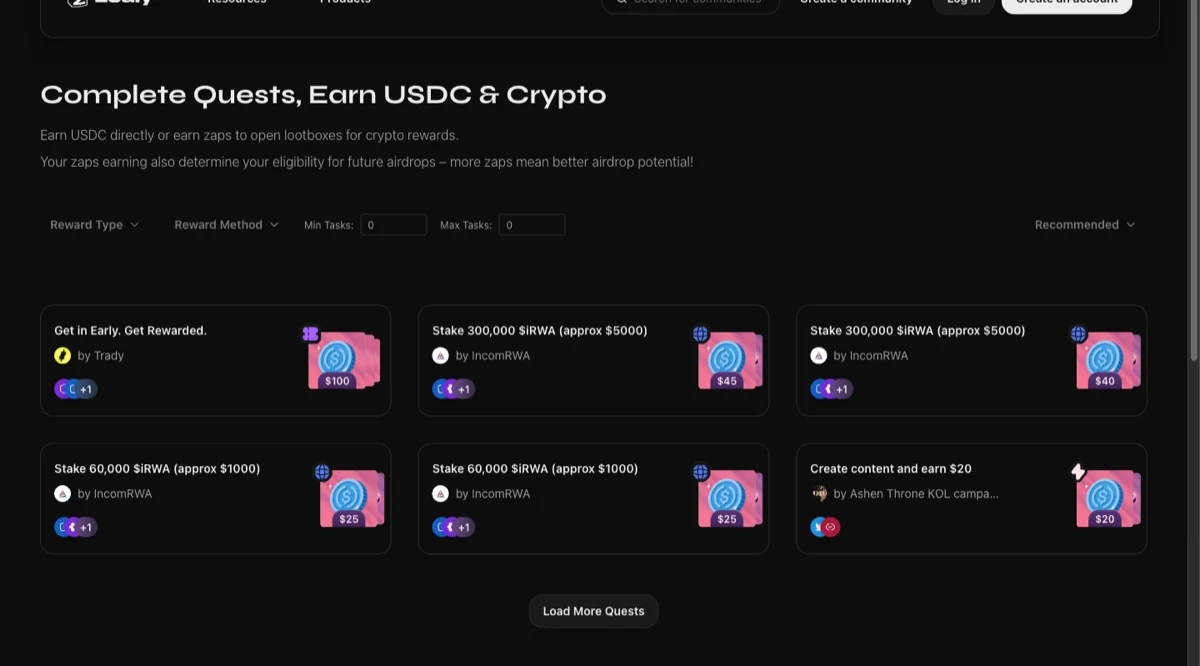
The public Earn board at zealy.io/earn, captured 7 August 2026. Amounts change constantly, so treat this as a snapshot rather than a rate card.
When we captured it on 7 August 2026, the first six quests paid $100, $45, $40, $25, $25 and $20. The titles matter more than the amounts. Four of the six were staking quests: two asked you to stake 300,000 $iRWA, around $5,000, to earn $45 and $40, and two asked for 60,000 $iRWA, around $1,000, to earn $25 each.
So on that day, the larger rewards mostly went to people staking a token — the reward is paid on top of a position that stays theirs — and the quests paying for time alone, like the $20 content quest on the same screen, sat lower. The top quest that day, at $100, was not a staking quest. Both kinds print what they ask for on the card, which is the point: you pick which trade you want before you start.
How sprint rewards get split
A sprint is a time-boxed competition inside a Zealy community with its own leaderboard and reward pool. Zealy's sprint documentation describes two ways to split that pool: proportionally, so your share matches your share of the XP earned during the sprint, or in ranked tiers that each take a set percentage.
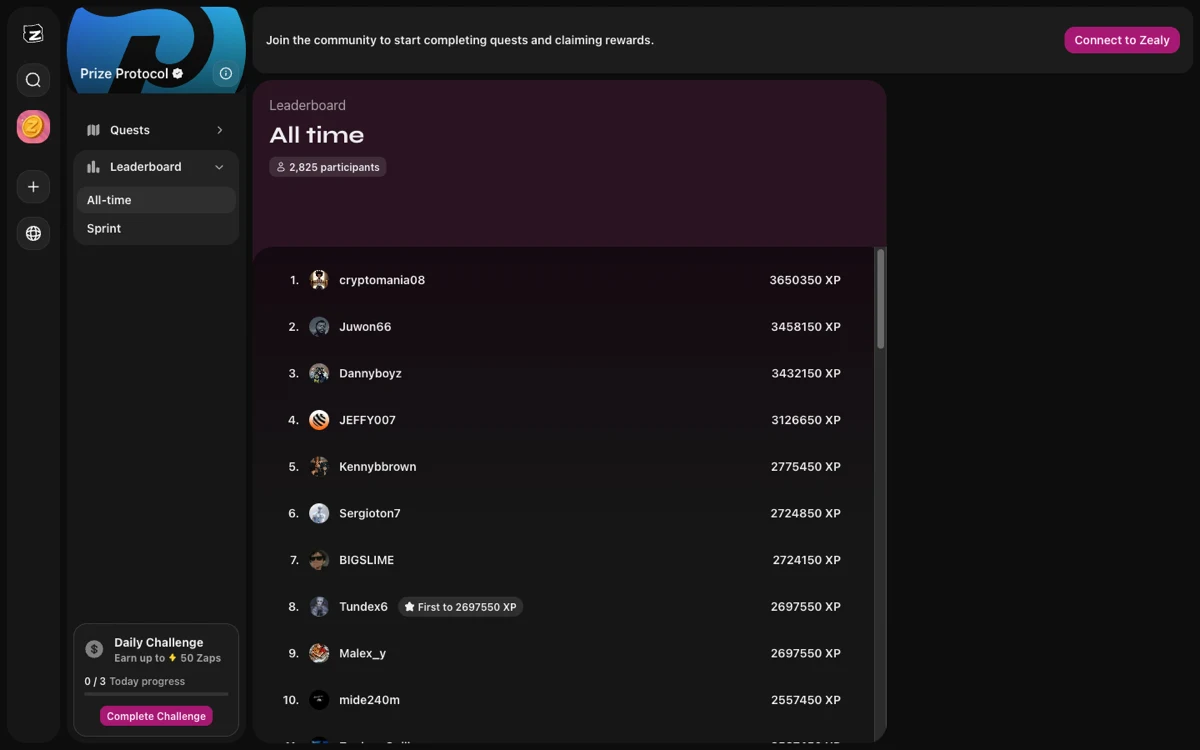
An all-time leaderboard on the public Prize Protocol community on zealy.io, captured 7 August 2026. Sprint leaderboards work the same way over a fixed date range.
USDC and Zaps sprint pools are distributed automatically when the sprint ends. Custom Rewards are not: Zealy's documentation says that for those, you "outline the prizes and manage the distribution yourself after the sprint ends" — the same guaranteed-versus-not split that runs through the rest of this article.
Your payout also depends on everyone else's effort, not only your own. Doubling your XP does not double your reward if the field doubled too. Sprints pay for relative position, so a quiet sprint can be worth more than a busy one.
How to withdraw money from Zealy
USDC you have earned sits as a balance in your Zealy account until you withdraw it. Withdrawing requires a verified email address for the one-time code and a linked Polygon wallet as the destination, and the minimum withdrawal is $1. Changing your wallet starts a two-day cooldown.
Those conditions were checked in the live product on 7 August 2026. Zealy does not publish its withdrawal fees or daily limits on any documentation page, and this guide no longer quotes a figure for either, because a number nobody can check against a public page is a number that goes stale silently. The withdrawal screen shows the fee and limit that apply to your account at the moment you withdraw — read it before you plan around an amount.
The condition that catches people out is the wallet. It applies at withdrawal rather than at signup, so you can earn for weeks before needing one, and then discover the last step needs a Polygon address.
Zaps, lootboxes and the Daily Challenge
Zaps are Zealy's internal points. You earn them by completing quests and spend them on lootboxes, which Zealy's rewards documentation describes as containing "rewards like tokens, memecoins, and NFTs". Zaps are not withdrawable themselves, so the lootbox is the conversion step between points and anything worth money.
The most predictable source of Zaps is the Daily Challenge. Zealy's earning documentation describes it as completing "3 quests daily to earn up to 50 Zaps", and calls it "the easiest way to build your Zap balance consistently".
In the live product on 7 August 2026, lootboxes came in three tiers costing 10, 50 and 250 Zaps, with daily limits of six, three and one, and each tier had its own prize table and odds. That pricing is not in Zealy's public docs yet. Treat the odds as odds: a run of low results is normal and is not evidence that anything is broken. Checking published odds and payout terms before you spend is the same habit we apply, at much higher stakes, in our audit of the best crypto gambling sites, where provably fair games exist precisely so players can verify them.
What Zealy does not guarantee
Community campaigns are the part to be careful with, and Zealy's earning documentation is direct about it. Rewards there range "from crypto tokens to NFTs, merchandise, and more", and then: "Since these aren't Zealy-operated, we can't guarantee distribution". Zealy states that it "actively removes suspicious communities", and advises members to "always verify community legitimacy before investing significant time".
The practical version: before committing hours to a community campaign, check which reward type its quests carry. Quests paying USDC or Zaps are delivered by Zealy. Quests paying Token or Other depend on the community, so it is worth checking whether that community has paid people before.
Do you need a crypto wallet to use Zealy?
No. You can create a Zealy account and complete quests with a Discord account, an email address, or a crypto wallet. A wallet is one of three sign-in options rather than a requirement, and members who never connect one can still earn XP, Discord roles and Zaps by completing quests.
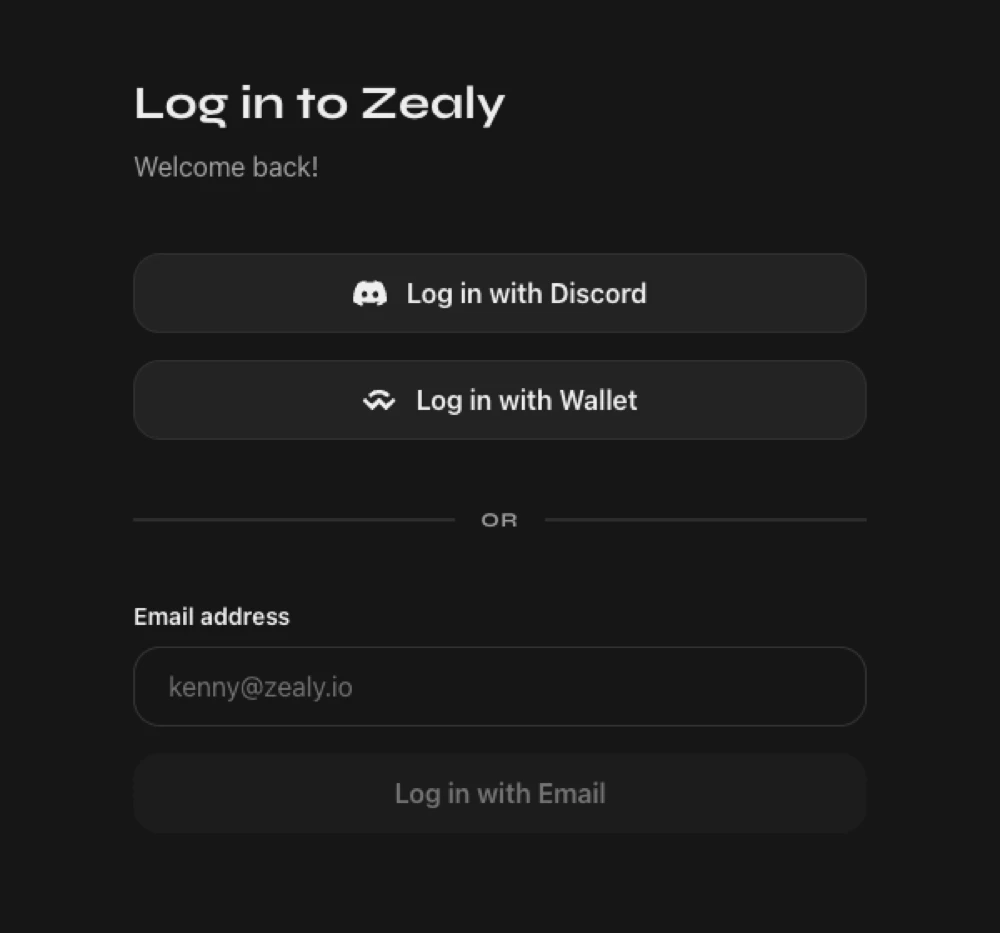
The Zealy login screen at zealy.io/login, captured 7 August 2026.
A wallet becomes necessary in two situations: withdrawing USDC, which needs a linked Polygon address — again, product-checked rather than documented — and joining a community that has switched on a wallet requirement for its own members.
What a Zealy quest looks like, and who checks your work
Zealy's quest documentation says you can add "up to five tasks to a quest", drawn from types that range from following an X account to uploading a file. It also sets the expectation for verification: tasks "mostly auto-verify", but "sometimes you may want manual checks, like confirming an image's content."
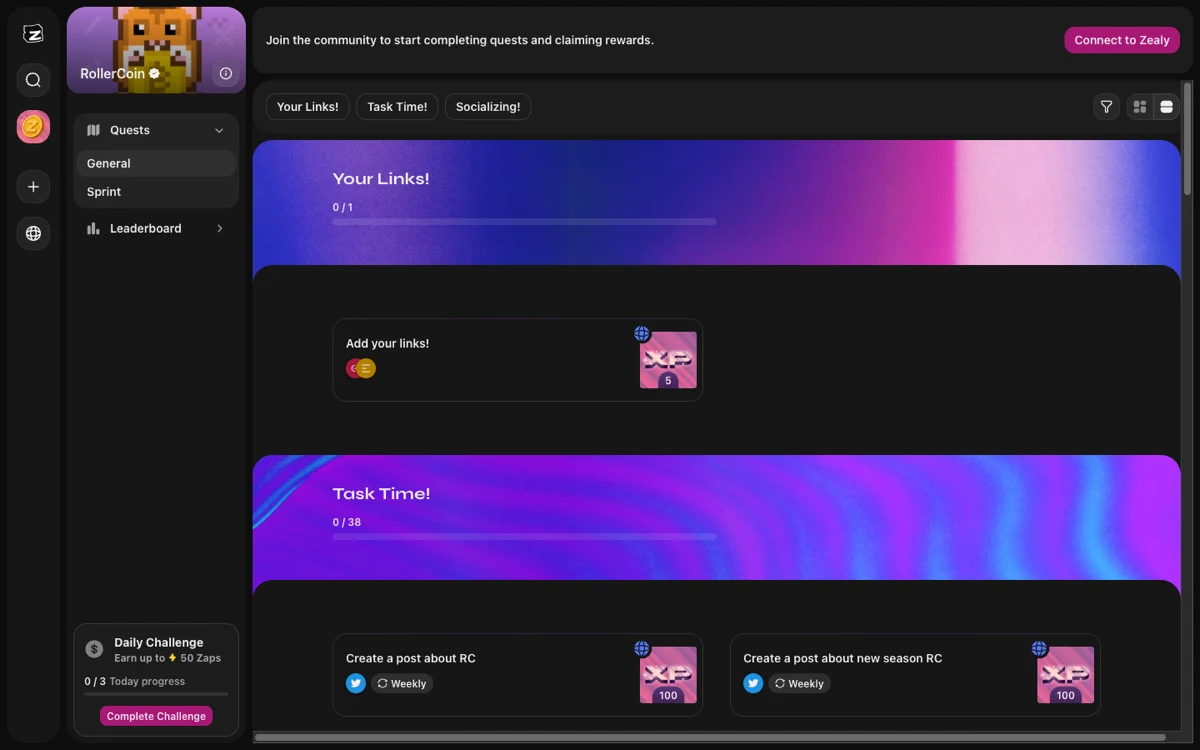
A public questboard on the RollerCoin community on zealy.io, captured 7 August 2026. Each card shows its task type and XP value; "Weekly" marks a quest that resets.
In the live product on 7 August 2026, the task types that could be routed to a human were text, file, URL, number and poll submissions — the open-ended ones, where a machine cannot judge the answer. When a task goes to review, a community member with the reviewer role reads your submission and accepts or rejects it. Rewards fire on acceptance rather than on submission, which is why a claim can sit as pending for a while. Zealy's review documentation adds that "starting with the Plus plan", communities can use AI to help review manual submissions.
Rejection is not always final: reviews can be reversed in both directions, and reversing an acceptance takes back the rewards, including a granted Discord role. Communities can also tighten the gate themselves. Zealy's security settings let a community require an invite to join, or require members to authenticate with specific methods for "additional bot protection", and quote-tweet tasks carry an optional setting that rejects duplicate submissions.
Why some reviews say Zealy only pays XP
Third-party reviews of Zealy often describe it as an XP-only platform. BitDegree's Zealy review, last updated on 11 May 2026, puts it precisely: "On Zealy itself, users can frankly only earn experience points." The same review notes that some communities offer "NFTs, whitelist spots, and similar" on top.
That framing was right for an earlier version of Zealy, and the qualifier is the part that has changed. USDC is now earned on Zealy itself, and Zealy's own documentation calls it "managed and guaranteed by Zealy". You can check that without an account: the public Earn board lists USDC quests with dollar amounts on them.
The rest of BitDegree's point still stands, and this article makes the same distinction. What a community chooses to do with your XP, and whether it sends a promised token, remains up to that community.
Is Zealy free?
Zealy is free for members. There is no fee to create an account, browse communities, or complete quests, and nothing is deducted when a quest reward is claimed. Withdrawing USDC is the one step with terms Zealy does not publish — the withdrawal screen states the fee and limit that apply to your account, and this guide deliberately quotes neither rather than printing a number that cannot be checked against a public page. Communities pay on a plan, starting with a free tier.
For communities, Zealy's billing documentation lists a Free plan with "access to most features, all integrations, and unlimited users", and says that communities reaching "the free plan limits" are asked to upgrade. Standard runs at $149–199 per month and Plus at $359–549 per month depending on billing period, plus a custom Enterprise tier. Paid plans include monthly claim-credit allowances, because Zealy bills communities per quest claim.
Choosing between platforms rather than deciding whether to join one? We've compared the three main options, including where the other two beat us, in Zealy vs Galxe vs Layer3.
Where to start: open the Earn board, filter by reward type, and pick one quest that pays USDC. A few minutes there will tell you more than any article can.