Short answer: Before you pick a platform, check two things the round-ups tend to skip. First, the minimum age it publishes — Prolific, Amazon Mechanical Turk and Google AdSense each require 18. Second, if you are an international student, what your visa permits: GOV.UK lists "be self-employed" among the things a Student visa holder cannot do, and UKCISA warns students not to accept work on a "freelance" basis. Then check the pay, which is smaller than the headlines and will not replace a job.
How this article is sourced. Zealy publishes it, and Zealy is one of the platforms described below. Every rule and rate links to the page it came from — a government page, a caseworker guidance PDF, or the platform's own help centre. Where Zealy comes off worse than the others, that is in here too.
This is not legal or immigration advice. It reports what official pages say and links to each one. Your own visa conditions and your institution's international student office are the authority on your situation, not a blog post.
Last verified: 18 August 2026.
Can you legally earn money online as a student?
If you are an international student, your visa decides what you may do, not the platform. The UK Student visa and the US F-1 both restrict it, and the UK rules name self-employment specifically — which is where a lot of earning advice starts. This section covers those two visas and nothing else.
GOV.UK's Student visa overview is unusually blunt. Under "What you can and cannot do", the "You cannot" list includes "be self-employed". Under "You can", the page says only "study" and "work as a student union sabbatical officer", followed by "You may be able to work - how much depends on what you're studying and whether you're working in or out of term-time."
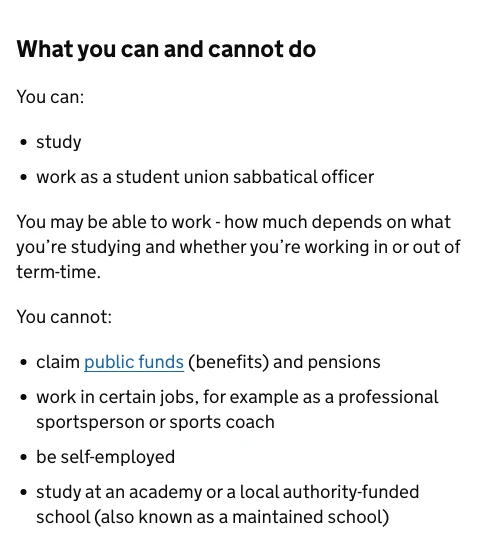
The "What you can and cannot do" section of the Student visa overview at gov.uk/student-visa, captured 18 August 2026.
The Home Office's own caseworker guidance, published for Home Office staff on 3 August 2026, says the same thing and then defines it. Page 98: "Students who are allowed to work must not: be self-employed or engage in business activity", with a narrow carve-out for someone who has applied on the Innovator Founder route. Page 99 defines the term — a student is engaging in business activity "if they are working for a business in which they have a financial or other significant beneficial interest in a capacity other than as an employee" — and gives as its first example "setting up a business as a sole trader or under a partnership arrangement and that business is either trading or establishing a trading presence".
That definition is what makes this worth reading before the ideas, because it is written in terms of how you are engaged rather than what kind of work you do.
UKCISA, the UK's national advisory body for international students, adds the version you are most likely to meet in practice: "Your employer might suggest that you work for them as a 'contractor' or on a 'freelance' basis. This is so that your employer does not have to do so much paperwork. You must not agree to this, as you might end up breaching your work condition."
The hours are separate from the prohibition, and they depend on your sponsor and your course. The same Home Office guidance sets out four cases across pages 97 and 98. A full-time course at degree level or above permits "part-time during term-time (up to a maximum of 20 hours a week)" where the sponsor is a higher education provider with a track record of compliance, or an "overseas higher education institution and the student is on a short-term study-abroad programme in the UK". At a compliant higher education provider, a full-time course below degree level gets 10 hours instead. Both may work full time during vacations, "including the period before the course starts". The other two cases permit no ordinary job at all. A full-time course at any level with a sponsor that is neither of those leaves only a work placement or a student union sabbatical role. And — this is the one to check — a part-time course at post-degree level even at a compliant provider, which the guidance answers with "no work, unless on a work placement that meets the requirements of ST 17". The guidance also separates volunteering from "voluntary work" and caps only the second, against the same total. Page 100 states that a student "can do voluntary work if they are permitted to work, but this work and any paid work must not exceed the total number of hours they are permitted to work during term time", and works the example: 20 permitted hours with 15 paid leaves 5.
The United States frames it differently and lands somewhere similar. USCIS states that "F-1 students may not work off-campus during the first academic year, but may accept on-campus employment subject to certain conditions and restrictions", and that for F-1 and M-1 students "any off-campus training employment must be related to their area of study and must be authorized prior to starting any work by the Designated School Official ... and USCIS". The Department of Homeland Security's Study in the States caps on-campus work — "If you participate in on-campus employment, you may not work more than 20 hours per week when school is in session" — opens with "The U.S. government takes working illegally very seriously", and spells out the consequence: "If your DSO knows you are working without permission, they must report it through SEVIS, meaning your SEVIS record will be terminated."
None of the pages cited here tells you which app counts as what. That question goes to your international student office, and it is worth asking before you sign up rather than after you have a balance.
The minimum age each platform publishes
Plenty of students are under 18, and several of the platforms here are not open to them. Prolific, Amazon Mechanical Turk and Google AdSense each publish a minimum of 18. Zealy, which publishes this article, states no minimum age in the three legal documents it links from its footer — a gap the next section covers rather than skips.
| Platform | Minimum age it publishes | In its own words |
|---|---|---|
| Prolific | Over 18 | "You must be over 18 years old, with a created and verified account, to take part in studies." |
| Amazon Mechanical Turk | At least 18 | "you accept this Agreement and represent that you are at least 18 years old" |
| Google AdSense | At least 18 | "we can only accept applications from applicants who are at least 18 years of age" |
| Zealy | None stated | Terms of Use and Cookie Policy dated 3 May 2023, Privacy Policy dated 25 May 2023, all read in full 18 August 2026 |
AdSense is the one with a route around it, and the route has a consequence worth understanding. Google's eligibility page says: "If you're under 18, you may have a parent or guardian sign up for AdSense using their own Google Account. If their AdSense account is approved, all payments will be made to the adult responsible for the site." The work can be yours. The money arrives in an adult's account. The same page routes YouTube creators to a separate product: "Please sign up for AdSense via your Blogger or host partner account, and for AdSense for YouTube via YouTube Studio." So a creator signs up through YouTube Studio rather than through this page, and YouTube's own monetisation terms are the ones to read for a channel.
Prolific carries a second gate that has nothing to do with age. Its participant help centre says Prolific is "available to participants in most OECD countries" and then prints the actual list, which we counted at 48 countries. It is not simply the OECD: it adds non-members such as Brazil, Singapore and Taiwan, and leaves out three members — Colombia, Costa Rica and Türkiye. The page adds that "Eligibility is based on where you currently live, not your nationality." If your country is not listed, the same page offers a waitlist and says "We can't guarantee access". Separately, it adds that "In some cases, we invite participants from unsupported countries to join", subject to photo ID.
Zealy's own terms name no minimum age
Applying this article's test to the company publishing it: Zealy's Terms of Use and Cookie Policy, both dated 3 May 2023, and its Privacy Policy, dated 25 May 2023, name no minimum age. Those are the three Zealy links from its footer, all read in full on 18 August 2026 and searched for every age word we could think of.
Here is the search, so you can judge it rather than trust it. All three are Notion pages, so they were opened in a real browser — plain retrieval returns only "JavaScript must be enabled". The full rendered text of each was searched case-insensitively for 18, 16, 15, 13, eighteen, sixteen, thirteen, age, aged, minor, underage, under the age, child, children, minimum age, parent, guardian, birth, date of birth, legal capacity, majority, adult and COPPA. Every hit was a false positive. Most matched inside a longer word or inside the company registration number 913 157 103 — age inside engagement, manage, homepage, pages and damages, parent inside transparent. One was a standalone number about something else entirely: the Cookie Policy's table says a Datadog cookie "is extended for an extra 15 minutes every time the user interacts with the website".
What the Terms of Use say instead is a single sentence in section 13.
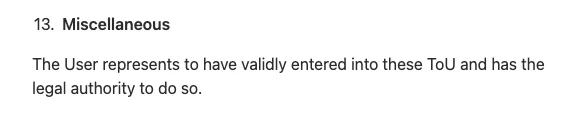
Section 13 of Zealy's Terms of Use, dated 3 May 2023, captured 18 August 2026.
"The User represents to have validly entered into these ToU and has the legal authority to do so." That puts the question of capacity on the person signing up rather than answering it with a number. Prolific, Amazon Mechanical Turk and Google AdSense each answer it with a number. This is a fair thing to hold against us, and if you are under 18 and reading this, the honest position is that our public documents do not tell you where you stand.
Two limits on what that finding covers. It is a statement about those three documents on that date, not about the signup flow, which was not tested. And a platform stating no age is not the same as a platform permitting any age — the law where you live applies regardless of what a terms page says.
What an evening actually returns
The two rates below are not the same kind of number. Prolific publishes an enforced floor of £6 / $8 an hour, which is a policy. The study below measured what Amazon Mechanical Turk workers actually earned, a median near $2, which is an outcome. Neither is a wage you can plan a term around.
Prolific, which connects researchers with paid participants, states in its researcher documentation: "We enforce a minimum hourly rate of £6 / $8, and recommend paying at least £9 / $12 per hour." Participants cash out once "combined approved balances across both currencies (GBP and USD) reach £6/$6 or more", to PayPal. Prolific applies a 72-hour cool-off between cash-outs to anyone who has recently added or updated their PayPal address or has made fewer than four cash-outs, dropping to 24 hours after the fourth, and says those waits "cannot be expedited or lifted under any circumstances".
So an hour of studies at the enforced floor reaches the cash-out threshold: £6 against £6, $8 against $6. That is the shape of the best case in this article — about an hour of work for about the price of a coffee, with the cool-off above applying between cash-outs rather than before the first.
Amazon Mechanical Turk sets no floor. A 2018 study published at CHI by Hara and colleagues logged 2,676 workers completing 3.8 million tasks and found a median hourly wage of about $2, with only 4% of workers earning more than the US federal minimum wage of $7.25 an hour. The same abstract gives the counterweight: "While the average requester pays more than $11/h, lower-paying requesters post much more work." The authors are also careful about what that rests on: "Our wage calculations are influenced by how unpaid work is accounted for, e.g., time spent searching for tasks, working on tasks that are rejected, and working on tasks that are ultimately not submitted." Both quotations above are the PDF's wording; arXiv's listing page carries the same abstract worded slightly differently. The logs were collected between September 2014 and January 2017, so treat it as evidence about one platform in that period rather than today's rate. The authors do not put the low median down to requesters simply paying badly. They report that requesters pay $11.58/h on average, and attribute the gap to a group posting large volumes of low-reward tasks and to unpaid time spent searching, on rejected work and on work never submitted.
Community quest platforms, Zealy included, sit at the small-and-fast end. They pay less per hour than paid research and pay it sooner, and a fair amount of what looks like a payout on a quest board turns out to be a prize draw or to require money in. That is the subject of a separate article, because the arithmetic is unflattering enough to deserve one: what "without investment" actually costs counts the whole Zealy board at one moment and shows what was left after the conditions.
Why this will not replace a job
Nothing on this page replaces a job, and the survey below says so plainly. Bankrate's side hustle survey of 2,616 adults, fielded 2–4 June 2025, found that side hustlers earned "$885 per month in 2025 on average" and that "Median side hustle income earnings are currently at $200 per month, down from $250 per month in 2024."
The distance between those two figures is the most useful fact a student can take from this article. An average of $885 against a median of $200 means a small number of high earners pull the average up while the typical side hustler makes $200 a month — and that is across all side hustles, online and offline, among adults who are mostly not juggling a full course load. Bankrate reports that "Only 27% of U.S. adults have a side hustle, the lowest percentage since 2017 and down from 36% last year". Two caveats: the sample is US adults, and the income is self-reported.
Set against a 20-hour term-time cap, or the handful of evening hours a course leaves, the arithmetic is not close. Someone earning the Prolific floor for four hours a week makes about £24 or $32 a week before anything else takes a share. That is real money for a student and it is not rent.
Which is a reason to be honest about what these platforms are for rather than a reason to skip them. Small, fast money that does not interfere with a degree is a perfectly good thing to want. Anyone selling it as an income replacement is selling you something, and the FTC's guidance on task scams describes what the sales pitch turns into: an app showing a rising balance, then asking you to deposit your own money to release it. "Never pay anyone to get paid, or to get a job. That's a sure sign of a scam."
Where to start, and what to plan around
Start with the two checks at the top of this article, because getting them wrong costs more than any of this pays. Confirm the platform's published minimum age applies to you. If you are on a student visa, read your own conditions and ask your international student office before you sign up — not after.
Then pick by how the money arrives, not by what sounds interesting. Prolific has the only enforced pay floor in this article and the shortest documented path to cash, which makes it the most predictable option if you live in one of its supported countries. Quest platforms pay smaller amounts sooner and are worth treating as pocket money. Building an audience pays nothing for a long time, and AdSense will not pay someone under 18 directly.
For the wider set of routes and what each one takes as its cut, our guide to earning money online goes through eight of them. Side hustle ideas that actually pay does the hourly arithmetic after costs, and what actually arrives when an app says it pays real money covers the form the money takes.
And plan around $200 a month, not $885. Anything above it is a good surprise.
One place to start: open Zealy's Earn board and open a quest before you count its reward. The card shows the amount and marks the method with a small unlabelled icon; the quest page names that method in words, with the winner count where there is one, and what the task actually asks you to do.