Short answer: Side hustle operators publish very different kinds of number, and none of them is the one you need — what an hour pays you after costs. Prolific enforces a floor of £6/$8 an hour on the researchers who run studies. DoorDash guarantees $22.13 an hour of active time in New York City, because the city's rules require a published minimum. Google Opinion Rewards prices a survey at $0.10 to $1.00 on iOS, and pays Google Play store credit on Android. Upwork, Fiverr and Etsy publish their own cut instead. This article takes each published figure and does the subtraction the lists skip: the platform's cut, the miles, the wait and the tax.
Disclosure: Zealy publishes this article, and Zealy is one of the eight. Zealy is in the table with the same columns as everyone else, and the section on Zealy leads with the number that looks worst.
How this is sourced. Every fee, rate and rule below is quoted from the company's own help centre, terms or pricing page, linked either at the sentence it supports or in the source list under the comparison table. Tax and mileage figures come from the IRS, and the participation figures come from the Federal Reserve's Survey of Household Economics and Decisionmaking. Several of these pages refuse automated retrieval — Upwork's help centre and its Connects Calculator, Etsy's fees policy, Fiverr's help centre and all three UserTesting help centres returned errors on 16 August 2026 — so those were opened in a real browser. That matters for one passage in particular: the UserTesting section rests on what four of its pages say, and three of the four will refuse an automated fetch if you try to check them that way.
This is not tax advice. The tax section quotes published IRS guidance and stops there. What you owe depends on where you live and what else you earn.
Last verified: 16 August 2026, except the two Zealy payout facts noted below, which were checked in the live product on 7 August 2026.
What "actually pays" means here
A side hustle pays if you can work out, before you start, what an hour of it is worth after costs. Almost no operator hands you that number. What each publishes is a fee, a price per task, an hourly rate, or a process by which a number reaches you later. This article treats those as inputs, not answers.
The reason is not evasiveness. For most of these routes an hourly rate genuinely depends on how fast you work, what you charge and where you live.
Two things make that gap matter more than it looks.
The first is scale. The Federal Reserve's 2024 Survey of Household Economics and Decisionmaking, published in May 2025, found that 20 percent of US adults performed gig activities in the month before the survey. Selling things was the most common at 13 percent, 9 percent did short-term tasks such as driving or odd jobs, and 4 percent did what the Federal Reserve calls platform tasks — short tasks arranged through an app or website.
The second is time. The same survey reports that gig work is not a job replacement for most people who do it: "Ninety-six percent of people who did gig activities said they usually spent less than 35 hours per week doing them and 70 percent spent less than 5 hours per week on them."
Five hours a week is the honest frame for everything below. At five hours, the gap between Prolific's floor of $8 an hour and its recommended $12 is $20 a week. That is worth having, and it is not worth reorganising your life around.
The Federal Reserve also asked how the work felt. Among people doing platform tasks, 61 percent agreed with the statement "I wish the pay was more consistent" — against 49 percent of gig workers overall. And 55 percent of platform-task workers said they were doing okay or living comfortably financially, compared with 75 percent of adults who did no gig activity at all.
Eight earning routes, and what each operator publishes about your pay
Asked what they tell you about your money before you commit time, eight side hustle operators answer in four ways: an hourly rate, a price per task, a cut of what you charge, or a process by which a number appears later. The shape matters more than the size, because it decides how much arithmetic is left to you.
Seven kinds of work, eight operators: freelancing appears twice, because Upwork and Fiverr price it very differently.
| Side hustle | What the operator publishes about your pay | What it takes from you | What you still have to work out |
|---|---|---|---|
| Paid research studies (Prolific) | A minimum hourly rate: £6/$8, recommended £9/$12 | Nothing from your reward | Whether studies you qualify for exist in useful numbers |
| Surveys (Google Opinion Rewards) | $0.10–$1.00 per completed survey on iOS; Google Play credits on Android, with no range in the help article | Nothing | Everything about volume — surveys arrive when Google sends them |
| Delivery driving (DoorDash) | Base pay $2–10+ per offer plus 100% of tips; where a local law requires a floor, an hourly or per-minute minimum — $22.13 per active hour in New York City | Your car, which the IRS costs at 76 cents a mile | Your idle time, which none of the four DoorDash pages cited in this article guarantees an individual Dasher any payment for; and your mileage, outside the markets where a regulator sets a per-mile rate |
| User testing (UserTesting) | The amount for each test, shown on your dashboard once you are accepted | Nothing | The rate before you apply, and how many invitations arrive |
| Freelancing (Upwork) | Its own cut: 0–15% per contract. Proposals to job posts cost Connects, at $0.15 each | The fee, plus the Connects spent on proposals that lose | Your rate, your win rate, and therefore your hourly |
| Freelancing (Fiverr) | You keep 80% of each order | 20% of the order | Your price, your volume, and the clearing period |
| Selling handmade or resale (Etsy) | $0.20 per listing, 6.5% of the sale, 3% + $0.25 processing | All three, charged on shipping as well as price | Materials, postage, hours, and whether anyone buys |
| Quests (Zealy) (we publish this) | The reward amount in type on each quest card; the reward method — paid to everyone, first come first served, drawn, and others — in words on the quest page | Nothing from the reward, though 21 of the 28 quests on the board when we counted asked for a token stake first | Which quests are draws rather than payouts — see below |
Sources, in order: Prolific, Google Opinion Rewards, DoorDash base pay and the New York City Earnings Standard, IRS, UserTesting, Upwork, Upwork Connects, Fiverr, Etsy, Zealy (its own Earn board).
The right-hand column is the real subject of this article. Nothing in it is a complaint: Etsy and Upwork publish their fees to the cent and in advance, and plenty of people do well on both. It is simply where the work of pricing an hour has been left to you.
The subtractions between a headline number and your money
Four things come off a side-hustle headline number before it reaches you: the platform's cut, the cost of doing the work, the wait, and tax. Only the first is usually mentioned. The second is the one that quietly turns a positive number negative, and for anything involving a car the IRS has already done the arithmetic for you.
The IRS publishes a standard mileage rate as the deductible cost of running a vehicle for business, and it changed part-way through 2026. For 1 July to 31 December 2026 it is 76 cents a mile, up from 72.5 cents for the first half of the year.
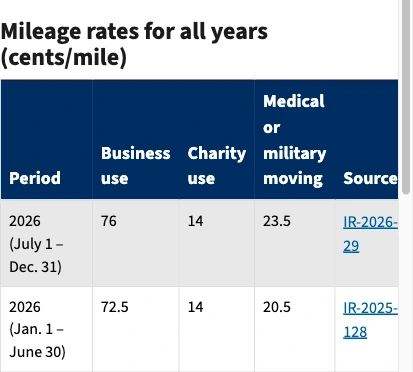
From the IRS page on standard mileage rates, captured 15 August 2026. The IRS sets the business rate from an annual study of the fixed and variable costs of operating a car, so it is an average. Yours may cost more or less.
Then tax. The IRS puts the self-employment tax rate at 15.3%, made up of 12.4% for Social Security and 2.9% for Medicare, and requires a Schedule SE once your net earnings from self-employment reach $400 in a year. That is separate from income tax and it starts at $400, not at some comfortable threshold further up. UserTesting states the position plainly on its own recruitment page: "UserTesting does not withhold any taxes from payments."
The wait is smaller but real. UserTesting's payments FAQ says it sends a test payment to your PayPal account "usually 14 days after you complete a test". Fiverr holds order payments through a clearing period, and its earnings page says "Eligible freelancers can skip the clearing period and get paid faster, with a 1% fee." Neither sum is large on its own, and both change what "paid today" means.
Where DoorDash publishes an hourly rate, a local law is the reason
DoorDash's published pay guarantees follow local regulation rather than company policy, and they stop at the city line. Its Guide to the New York City Earnings Standard states that "NYC Dashers earn a minimum earnings rate of $22.13/hr* for their individual active time on the platform" — the "Standard Method" the city sets out, which DoorDash adopted in March 2024.
Its Seattle page prices the same idea in different units: Dashers there "earn the greater of: The minimum pay rate OR $5.34 per offer", where "In 2026, the minimum pay rate is: [engaged miles] x $0.80 + [engaged minutes] x $0.47."
Both pages name a law as the cause. The New York page says "New rules impacting Dasher pay have been in effect in New York City since December 4, 2023. The new rules require that platforms in New York City pay Dashers according to one of the two pay methods". The two are the Standard Method, $22.13 an active hour, and an alternate method of "$36.88/hr* for engaged time"; DoorDash says it moved to the Standard Method in March 2024, so the first is the one that applies. The Seattle page says "Since January 13, 2024, a new law impacting Dasher experience on the platform has been in effect in Seattle", and sets a rate per active minute and active mile rather than per hour. New York City's Department of Consumer and Worker Protection confirms the number and the date: the minimum pay rate "will increase from $21.44 an hour to $22.13 an hour for both grocery and food delivery workers, a 3.2% increase that is set to take effect on April 1, 2026." That announcement is dated 26 January 2026.
So the useful generalisation is not about DoorDash. Where a floor exists for gig work, a legislature usually wrote it — which means it stops at that jurisdiction's boundary, it is revised on the regulator's schedule rather than the company's, and the two versions quoted above do not even share a unit. New York prices an active hour; Seattle prices an engaged minute and an engaged mile. DoorDash's New York page notes its own revision cycle: "All pay rates are updated annually on April 1."
Read the word "active" before you plan around $22.13. DoorDash's own Earn by Time page supplies the arithmetic that turns that rate into your rate, and it is unusually explicit: "your active time is when you're engaged in completing an offer, which begins the moment you accept an offer and ends once you drop it off to the customer (or last customer if there are multiple orders) or the offer is canceled", while "your idle time is the time you spend when you are waiting for an offer", and "your active time + your idle time = your dash time." The guaranteed rate attaches to the first term.
So the honest form of the New York number is a division, and you supply the divisor. To take one arithmetic example rather than a claim about how dashes actually go: two active hours inside a four-hour dash earn $44.26 at $22.13 an active hour — $11.07 for each hour you were away from home, before the car. Whatever your own split turns out to be, that is the calculation the guarantee leaves to you.
Two further qualifiers sit on the New York figure, both on DoorDash's own page. It is settled weekly, not per shift: DoorDash reviews the week's earnings and, "If DoorDash pay is below the minimum earnings, we will add a pay adjustment the following Monday morning." And only the right deliveries count — "The Earnings Standard applies to Dashers fulfilling deliveries with a pickup or drop-off location in New York City." DoorDash's worked example puts both together: 300 minutes of active time in a week produces a minimum of "[5 hours x $22.13/hour] = $110.65", topped up on the Monday if the week's pay fell short.
Then the car. Outside those regulated cities, DoorDash explains base pay as a per-offer range: "This ranges from $2-10+ when a Dasher chooses to earn per offer, depending on the estimated time, distance, and desirability of the offer." At the IRS rate for the second half of 2026, six miles of driving carries about $4.56 of vehicle cost, which is more than the bottom of that range. That does not make the offer a loss, because tips sit on top and DoorDash says Dashers keep "100% of tips", but it does mean the base pay on a small offer is not covering the driving, and a stranger's discretion is what closes the gap.
Two conditions on Earn by Time mode are worth knowing before you treat it as a salary. DoorDash says "tips may be less frequent when you choose to earn by time", and it limits declines to one an hour. On what happens if you decline a second, the page says two different things. Its summary reads "If you decline or unassign more than one offer in an hour, your Earn by Time mode dash will automatically end", while its FAQ lower down reads "If you decline or unassign yourself from a second offer within the same hour, you'll be given the option to end your dash or switch to Earn per Offer mode to continue earning." Either way the hourly guarantee for that session is over; whether you are asked first is a question for the app.
If you want to know what delivery driving pays you, the method is the same everywhere: log your active hours and your total hours for two weeks, log the miles, multiply the miles by 0.76, and subtract. An hourly figure quoted without that subtraction is a gross number wearing the clothes of a net one.
Freelancing and selling publish the fee, and leave the pay to you
Upwork, Fiverr and Etsy are three of the most common side-hustle recommendations, and all three publish the same kind of number: their own cut, precisely and in advance. None publishes a rate you could plan against, because on all three you set your own price. So their sections are about subtraction, and on Upwork one subtraction comes first.
Upwork's Freelancer Service Fee "ranges from 0% to 15% per contract", is shown to you before you bid, and is fixed once the contract begins. That part is fair and clearly explained.
The part that surprises people is Connects. Upwork describes them as "the virtual tokens freelancers use on Upwork to submit proposals for jobs, as well as for various ad products, such as boosted proposals and the Availability Badge", and says they "cost $0.15 (USD) each and are sold in bundles". How many a given job needs is not a fixed number: Upwork's Connects Calculator says the amount "is determined by a range of factors, including project size, scope and market demand". Then there is the refund policy.
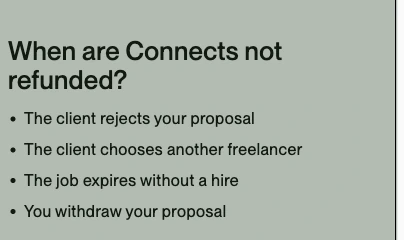
The four cases Upwork lists under "When are Connects not refunded?", from its help centre article on Connects, read 15 August 2026. Under the facing heading, "When are Connects refunded?", Upwork lists two: a client cancelling before a contract is made, which it notes "does not apply to expired posts", and Upwork removing a post for violating its Terms of Service. Those are "credited back to your account for reuse — not for a refund of their cash value". Connects can also come back a third way, described elsewhere on the same page: win an interview with an established client and some of what you spent "may show up as a refund".
So a proposal that loses is a proposal you paid for. Upwork's Connects Calculator is careful about what a Connects balance buys: the number it suggests "is not a guarantee that you can submit a specific number of proposals and win work opportunities".
Upwork does hand out Connects without charge. Under the heading "How do I get free Connects?" it lists several routes, badges among them — "You earn 30 free Connects for each badge: Rising Talent, Top Rated, and Top Rated Plus" — along with a monthly allocation that "some freelancers may receive" and a partial rebate for volume: "You may* earn 12 free Connects when you: Submit three or more proposals AND Spend a total of at least 54 Connects doing so", asterisked as a test that "may not be awarded to every freelancer". The Connects Calculator adds that "Connects expire one year from the date of issue". What a brand-new account starts with is worth checking inside your own account rather than in an article: Upwork's help centre and its Connects Calculator describe the new-user bonus differently, and this article will not adjudicate between two of a company's own pages.
The shape of the cost, though, is clear enough to plan around. Pitching yourself at a public job post has a price whether or not you win, and it is a price a beginner pays more often than an established freelancer does, because the proposals least likely to succeed are the early ones.
Fiverr's arithmetic is simpler and stated on its earnings page: "For every order you complete, you earn 80% of the purchase amount, including Gig Extras and tips."
Etsy itemises its fees on its selling page: $0.20 to publish a listing, active for four months or until it sells; a 6.5% transaction fee; and, through Etsy Payments, a payment processing fee that the US version of the page gives as 3% + $0.25, under the note that "Payment processing fees vary by bank country". Offsite Ads are charged separately again, on sales that come through them.
Both fees are charged on more than the item price, and Etsy's Fees & Payments Policy says so on both counts, in the US rendering of that page — the UK one says "delivery" where this says "shipping". On the transaction fee, it is "6.5% of the price you display for each listing plus the amount you charge for shipping and gift wrapping". On the processing fee: "The payment processing fee is assessed on the total amount of the sale, including tax and shipping."
Work an example. Sell a $20 item with $5 of shipping you set, and Etsy's published US fees come to about $2.83: $1.63 transaction, $1.00 processing, $0.20 listing. That is before the materials, the postage you actually pay, and the hours — and before the currency conversion fee and one-time shop set-up fee the same page also lists. What Etsy cannot tell you is whether anyone will buy the thing.
Prolific, Google Opinion Rewards and UserTesting: a rate, a price, and a process
Prolific pays people to take part in academic and commercial research studies, and puts its hourly figure on a public page written for the other side of the market. Its guidance to researchers reads: "We enforce a minimum hourly rate of £6 / $8, and recommend paying at least £9 / $12 per hour."
Prolific's participant help centre calls that an absolute minimum.
Be clear about the limits of that floor. It is a rule about how researchers must price a study, and Prolific enforces it against the clock rather than the estimate: its page on underpaying studies says it "calculates the effective hourly rate based on the median actual completion time of submissions, rather than the estimated time provided by researchers", and that researchers who do not comply with its payment policies "will have their accounts suspended until they resolve all underpaying studies". It is not a promise that studies will be available to you, and eligibility depends on the demographic screening each study applies. A published floor on work you cannot get is still worth more than no floor at all, but it is not an income.
Getting paid runs through PayPal. Across the eight articles in Prolific's help centre collection on cashing out, PayPal is the only destination available. Asked "Can I use an alternative payment method to PayPal?", Prolific answers with a hedge of its own: "At present, payments can only be transferred through PayPal, unless we've explicitly told you otherwise." Prolific says you must connect a PayPal account before you can cash out, sets the threshold at a combined £6/$6 approved balance, and applies a 72-hour cool-off between cash-outs if you have recently changed your PayPal address or have made fewer than four cash-outs.
Google Opinion Rewards publishes a price too, and which price depends on your phone. Its iOS help article says: "You will receive between $0.10 and $1.00 per survey completed." Its Android article describes a different reward and puts no per-survey range on that page: "we'll provide Google Play credits", and "The amount of Google Play credits you receive for answering surveys can vary and is dependent on the number of questions in the survey and the amount of time it takes to answer the survey." Google's help pages also vary by country, so check your own region's copy.
Either way the catch is volume, and Google states it plainly: "At this time the only way to answer a survey is when we notify you that there is one available to answer." You cannot decide to do more of it. On iOS that makes it a genuinely passive few dollars rather than a side hustle in any planning sense. On Android it is store credit rather than money you can move, which is a different thing before you count it.
UserTesting is the clearest case of a fourth kind of answer: an operator that meets the pay question with a process rather than a figure. Asked "How much do tests pay?", its contributor support centre says "Payment amounts vary based on the test type, duration, and customer demand—your dashboard will always show you the amount you'll get paid for each test." Its participant support centre gives the same answer, its customer-facing knowledge base gives the same answer to the researchers buying the tests, and its public recruitment page says the same thing in its own words: "The reward amounts for each test vary and depend on factors like test type, duration, and customer demand". Four pages, one answer, and the number lives behind the application. That is a legitimate way to run a marketplace — the price of a test genuinely varies — and it also means none of those four pages puts a per-test rate in front of you before you apply.
What Zealy pays, and the number on our own board that does not mean what it looks like
Zealy publishes this article, so here is the count that looks worst, done on Zealy. On 15 and 16 August 2026 its public Earn board held the same 28 quests and the same $272.55 of USDC. Twenty-one of them, all from one project called IncomRWA, required staking $iRWA first, and those 21 held $221.75 of the total.
We loaded every quest both days, clicking "Load More Quests" until the button disappeared. The board renders in the browser, so the server sends a crawler an empty grid and nothing we can point you at will confirm this count. You would have to open the board yourself, on a day when it holds different quests.
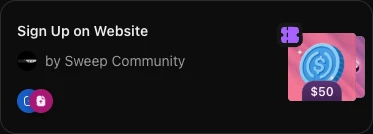
That leaves four USDC quests with no token stake attached, totalling $50.80 — and $50.00 of that is a single quest, a Sweep Community website signup. Here is its card on the Earn board:
And here is the Rewards block on the quest itself:
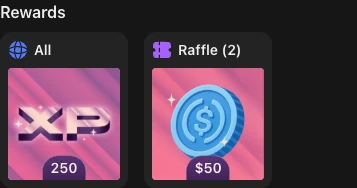
Captured at a phone-width viewport on 16 August 2026: the first from Zealy's Earn board, the second from the quest's own page. The 250 XP goes to everyone who completes the quest. The $50 is set to Raffle (2) — two winners, drawn — which makes it a lottery ticket rather than a payment.
Look at the two images together and the small purple ticket in the corner of the card is the same glyph the quest page puts next to the word "Raffle". So the method is on the card, encoded as an icon; a quest paid to everyone carries a blue globe there instead, the mark the quest page labels "All". What is only on the quest page is the word and the number of winners. The Earn board also has a Reward Method filter — Everyone, FCFS, Raffle — so a reader who knows to look can take draws off the board without opening anything, and can see that "paid to everyone or drawn" is not the only choice. What the card does not do is spell it out in type next to the amount, and the amount is in type. A $50 quest reads as $50 either way.
Take the raffle out of the total and the entire guaranteed, no-stake USDC on the board across both days was $0.80, spread over three quests: $0.50 from Amadeus Protocol and $0.15 twice from Ratehopper AI, all three set to pay everyone who completes them. The Amadeus one asks you to boost a Discord server, which is a paid Discord feature, so even that is not quite free. Three further quests paid no USDC at all, only Zaps — 8, 5 and 3 — plus XP, all three from Filecoin.
That is the honest shape of the number, and it is worth being blunt about what it means for you. On both days we looked, $221.75 of the board's $272.55 — a little over four fifths — sat behind a token stake, and the largest quest that did not was a draw. Eighty cents is not an evening's work by any measure. The reward is attached to the task and shown before you start, which is more than Etsy or Upwork can offer — but the amount is set in type and the method is set in an icon, and those are not read with equal attention. Open the quest. How many quests exist on any given day is outside your control and outside ours, because communities fund them.
Two more things worth knowing before you count Zaps as money. Zealy's own contributor documentation says Zaps are what you "use to open lootboxes" in the Reward Hub, which makes a Zap a chance at a reward rather than a balance. Separately, under a heading for campaigns that communities run themselves rather than Zealy, that documentation carries the bullet "Do your research - Since these aren't Zealy-operated, we can't guarantee distribution". That caveat is about those community campaigns, not about the Zaps and USDC above, and it is worth knowing which part of the board you are on.
USDC withdrawals go to a wallet you control, on Polygon, at a $1 minimum. Both were checked in the live product on 7 August 2026; Zealy's contributor documentation does not state either, though the chain is named elsewhere in the docs in the context of token tasks. Our full guide to Zealy covers how the quest and reward flow works, and how to earn crypto without buying any compares quest boards with faucets and learn-to-earn.
How to check any side hustle in ten minutes
Four questions, in this order, on any side hustle you are considering: what the operator publishes about your pay, what the work costs you to do, how the money gets out, and how many hours you will realistically give it. The first two can be answered from the company's own site, and they decide whether the rest matters.
Find what the operator publishes about your pay, and check which words qualify it. Look on the company's own help centre rather than a review site, then read the qualifiers rather than the number. "Active" hours are not your hours. A "guaranteed" rate may be guaranteed in one city. A reward amount may be an entry into a draw. If all you can find is a fee, then any earnings figure you go on to read about that route did not come from the operator, and people who write up their side hustles are not a random sample of the people doing them.
Add up what it costs you to do. Miles at the IRS rate, materials, postage, subscriptions, and anything you pay for the right to apply. This is where delivery work and craft selling change shape.
Find how the money gets out, and when. Threshold, rail, wait, and whether the rail is one you already have. Our comparison of money-earning apps works through the cash-out minimums and dormancy clauses of seven of them, including the two that can charge a fee against a balance you have already earned.
Assume five hours a week at most. The Federal Reserve found that 70 percent of people doing gig activities spent less than five hours a week on them. Multiply your best honest estimate of the hourly rate by five, look at the weekly number, and decide against that instead of against a monthly figure from a listicle.
If the wider question is which routes exist at all, our guide to earning money online covers the ones that are not side hustles in the gig sense — and is honest about the same thing this article is.
One place to start: pick the side hustle you are most tempted by, find the largest number it advertises, and then find the page that qualifies it. The gap between those two pages is the thing worth knowing.