Short answer: Eight routes actually pay: freelancing, paid research studies, microtasks, surveys, cashback apps, selling things you make, community quests, and building an audience. None of them pay what the headlines suggest. Across all side hustles, online and offline, US side hustlers earned a median of $200 per month in 2025, against an average of $885.
How this article is sourced. Zealy publishes it, and Zealy is one of the platforms described below. Every external pay rate, fee and threshold links to the page it came from, usually the platform's own help centre.
Two sets of figures have no public page behind them, and both are ours. Zealy's withdrawal terms were checked in the live product. The Earn board count further down is our own tally, taken by hand on 10 August 2026. The board renders its quests in the browser, so the server sends a crawler an empty grid, and archived captures of the page carry no quest data either. Nothing published can confirm our count. You would have to open the board yourself, on a day when it holds different quests. Both figures are labelled where they appear.
Last verified: 10 August 2026, except Zealy's withdrawal terms, checked 7 August 2026. Upwork, Ibotta and Etsy block automated retrieval, so those three figures were confirmed by hand in a browser.
How much do people actually earn online?
Most people earn a modest amount. Bankrate's side hustle survey of 2,616 US adults, fielded 2–4 June 2025, found that side hustlers earned an average of $885 per month and a median of $200 per month, down from $250 in 2024. Only 27% had a side hustle at all.
The distance between those two figures is the most useful fact in this article. An average of $885 against a median of $200 means a small number of high earners drag the average upward while the typical person makes $200. Any article quoting only the average is describing people you are statistically unlikely to be.
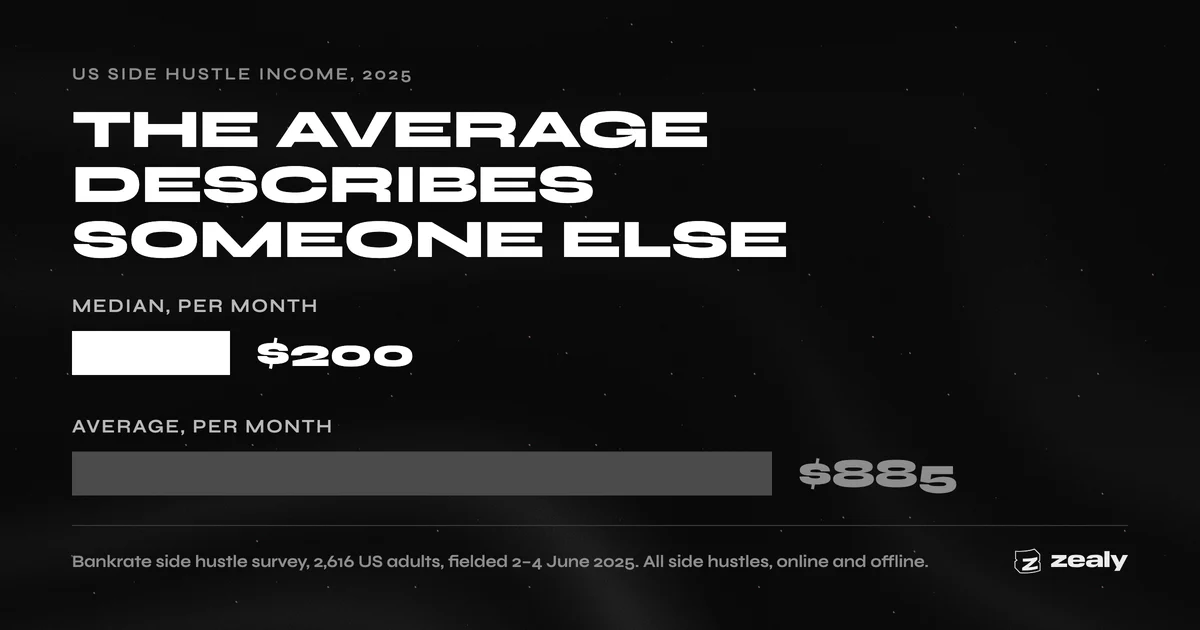
Two caveats worth stating: the survey covers US adults and all side hustles, online or not, and it relies on self-reported income from a non-probability online sample.
What each route pays, side by side
Eight routes trade different things for money: hours, attention, inventory, audience, or capital. Each has its own moment at which the money becomes yours, ranging from the same afternoon to never. Of the routes setting a minimum balance, Zealy's $1 is lowest and Ibotta's $20 highest. Building an audience waits longest: YouTube pays no ad revenue below 1,000 subscribers.
| Route | What you sell | Published pay evidence | The platform's cut | Money reaches you |
|---|---|---|---|---|
| Freelancing | Skills and hours | Set by you and the client | Upwork: 0%–15% per contract | After a client hires and approves work |
| Paid research | 20–40 minutes at a time | Prolific enforces a floor of £6 / $8 per hour | None stated for participants | At £6/$6 approved balance, via PayPal |
| Microtasks | Minutes at a time | Amazon Mechanical Turk: median ~$2/hour in a 2018 academic study | Not published for workers | After a 10-day holding period for new workers |
| Surveys | Attention | Google Opinion Rewards: $0.10–$1.00 per survey | Varies | Google Opinion Rewards on iOS: at $2.00 accrued, via PayPal |
| Cashback | Receipts | Not published | Varies | Ibotta: $20 minimum and a 7-day wait |
| Selling things | Inventory and making time | Set by you | Etsy: $0.20 per listing plus 6.5% | When an item sells |
| Audience | Years of published work | Ad revenue share | Varies | Ad revenue only after 1,000 subscribers plus 4,000 watch hours or 10M Shorts views; fan funding from 500 |
| Community quests | Small verified actions, or staked capital | Zealy's public board on 10 Aug 2026: one person could collect $52–$77 outright from the 10 time-only quests, once the one that is a draw is excluded | Zealy: none to claim (product-checked) | At a $1 balance, to a Polygon wallet (product-checked) |
The last column matters more than the third. The pay rate decides how much you earn; the payout condition decides whether you ever see it. Most articles about earning online cover the first and skip the second.
Selling your skills pays the most, and pays nothing for weeks
Freelancing has the highest ceiling of any route in this article, because a client pays for expertise rather than per task, and the marketplace takes a percentage instead of a cap. Upwork's help centre states that its Freelancer Service Fee "ranges from 0% to 15% per contract" and that once a contract begins, "the fee is fixed and won't change."
The commonly repeated claim that Upwork takes a flat 10% is out of date. The published range is 0% to 15%, set per contract, which means the fee is something to check before accepting rather than a constant to plan around.
What freelancing does not give you is a fast first payment. You earn nothing until someone hires you, and on a marketplace with no reputation yet, that can take weeks of unpaid proposals. Paid research and quests can pay on day one, and pay far less in total. That is the actual trade.
Paid research pays a real hourly rate; microtasks mostly do not
Paid research and microtasks get grouped together constantly, and the gap between them decides where you should spend an evening. Prolific, a paid-research platform, enforces a published floor of £6 / $8 an hour. Amazon Mechanical Turk sets none, and the largest study of what that produced measured a median of about $2 an hour across 2015 and 2016.
Prolific, which connects academic and commercial researchers with paid participants, publishes an enforced floor. Its researcher documentation states: "We enforce a minimum hourly rate of £6 / $8", and recommends at least £9 / $12 per hour. Participants can cash out once their approved balance reaches £6/$6, and Prolific says payment "will arrive in PayPal within 24 hours, typically much sooner." New accounts have a 72-hour cool-off between cash-outs until the fourth one.
Amazon Mechanical Turk has no such floor, and the largest measurement of what that produces is bleak. A 2018 study published at CHI by Hara and colleagues logged 2,676 workers completing 3.8 million tasks and found a median hourly wage of about $2, with only 4% of workers earning more than the US federal minimum wage of $7.25 an hour. The authors call it "the largest AMT worker log data in existence" for this kind of analysis. The authors are careful about what that figure rests on: "Our wage calculations are influenced by how unpaid work is accounted for, e.g., time spent searching for tasks, working on tasks that are rejected, and working on tasks that are ultimately not submitted." Count that unpaid time and the hourly figure falls further.
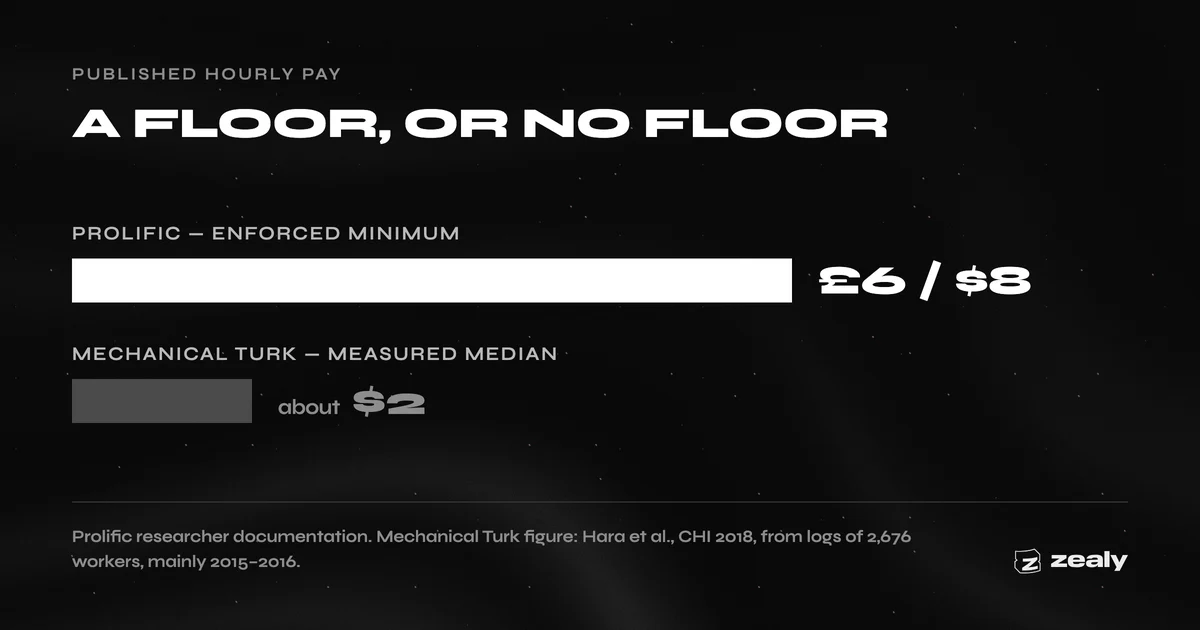
The logs behind that study were collected between September 2014 and January 2017, and the authors say the analysis "mainly reflect[s] the activities from the end of 2015 to the end of 2016". Treat it as the best published evidence on one platform and not as today's rate. The structural point still holds: when a platform sets no floor, the market clears well below minimum wage.
Surveys and cashback apps hold your money at the door
Survey and cashback apps such as Ibotta, Fetch, Rakuten and Google Opinion Rewards do pay real money. What each one also does — and what almost no listicle mentions — is set a minimum balance, a waiting period, or an expiry date between you and the payout. The threshold matters more than the per-survey rate.
Ibotta's help centre lists three conditions before you can withdraw anything: "Reach the earnings threshold of at least $20, Successfully redeem at least one (1) offer, AND Wait at least 7 days after redeeming your first offer or purchasing a gift card." Fetch states that "A minimum of 3,000 points are needed to redeem most rewards", then restricts a first redemption to $10, $25 and $50 rewards. Fetch's own blog puts the rate at roughly 1,000 points to $1, so a first redemption needs closer to 10,000 points. Fetch points also expire after 90 days of account inactivity. Rakuten pays quarterly, and only if you have "minimum confirmed earnings of $5.01 Cash Back before the next payment date."
Google Opinion Rewards is the clearest of the group about what it pays. Its iOS help page states "You will receive between $0.10 and $1.00 per survey completed", and pays that in cash through PayPal once $2.00 has accrued. The Android app pays Google Play credit instead, and Google's Android help page states that those credits "expire one year from date of credit per the Google Opinion Rewards Terms of Service". Google publishes no per-survey range for Android. The iOS balance can expire too: Google says that if you never accrue $2.00, "the balance will expire one year from the last survey you took".
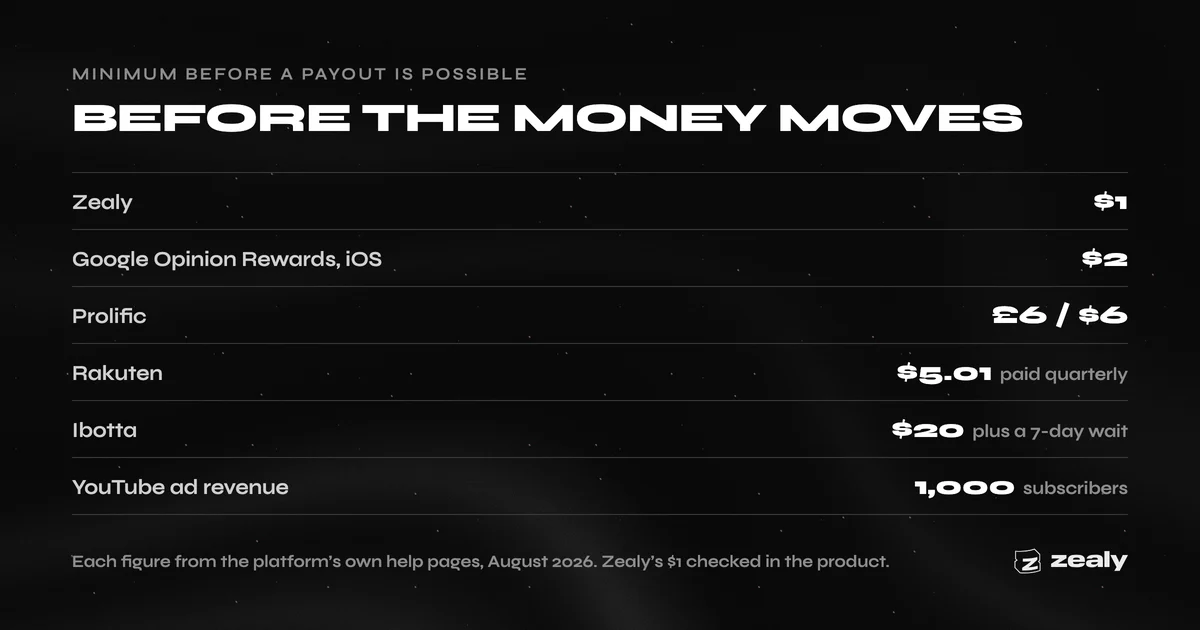
Read each app's cash-out page before installing it. The threshold, the payout form and the expiry rule are the three facts that decide whether the money reaches you, and all three usually sit one page away from the sign-up button. Our comparison of money-earning apps by their exit terms goes through all of them app by app, including the two whose terms let them charge against a balance you stop touching. For the payout form specifically — whether what arrives is cash, a gift card, store credit, a draw entry, a lootbox or a stablecoin — see what actually arrives when an app says it pays real money.
Building an audience pays nothing for a long time
Building an audience has the longest gap between the work and the money, and a published threshold defines it. YouTube pays no ad revenue until a channel reaches 1,000 subscribers plus either 4,000 qualified watch hours in the last 12 months or 10 million qualified Shorts views in the last 90 days.
Those Partner Programme thresholds are the gate for ad revenue. A lower tier unlocks fan funding in select countries: 500 subscribers, three valid public uploads in the last 90 days, and either 3,000 valid public watch hours in the last 12 months or 3 million valid public Shorts views in the last 90 days.
Nothing about those numbers is unreachable. What they mean in practice is that you will publish for months before the first payment is possible at all, and that most channels never cross the line. If you need money this month, this is the wrong route; if you are building something you would make anyway, the economics change entirely.
Selling things means paying before you earn
Marketplaces charge you to be there, and the charge does not depend on whether anything sells. Etsy's Fees & Payments Policy states a listing fee of "$0.20 USD for each item that you list", charged "whether or not the listed item sells". On a sale, Etsy takes a further 6.5% of the display price plus shipping.
Run that arithmetic before stocking anything. Fifty listings that do not sell cost $10 every four months. That is a small number, and it moves selling into a different category from selling your time: you can end a month down. Staking quests sit in a third category again — the reward is paid on top of a position you still own — and the Zealy section below sets out how to read one.
What Zealy's quest board actually paid
On 10 August 2026, Zealy's entire public quest board held 35 quests. Thirty-one of them paid USDC, totalling $414.05, at a median of $10 each. Four paid Zaps, Zealy's internal points. Anyone can check this: the Earn board is public and needs no account.
We counted it with no filters applied and every "Load More" exhausted, which is what makes the numbers below checkable instead of promotional.
Correction, 16 August 2026. This section originally counted a $50 Sweep Community signup quest as a payout. It is not one. Opening that quest shows its reward method set to Raffle (2) — two winners, drawn — verified on the rendered quest page on 15 and 16 August 2026. The quest has been removed from the time-only totals below, which brings the range down from $102–$127 to $52–$77, and the table below now marks it. The lesson this article should have carried from the start: the Earn board card prints the reward amount in type and marks a draw only with a small ticket icon. The word "Raffle" and the number of winners are on the quest page. Open the quest before you count the number — side hustle ideas that actually pay shows both screens side by side.
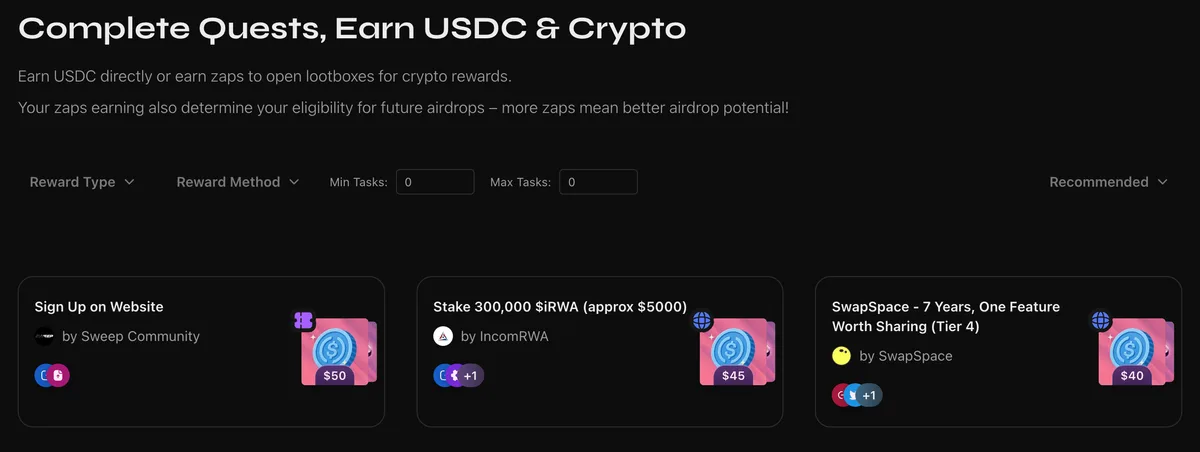
The top of the public Earn board at zealy.io/earn, captured 10 August 2026 with no filters applied. The screenshot shows the first three of the 35 quests counted below; the rest were counted by hand on the same page. The board changes constantly, so treat this as one day's snapshot and not a rate card.
The distribution matters more than the total. Twenty-one of the 31 USDC quests were staking quests from a single community, IncomRWA, each paying USDC for staking a quantity of its own token. The quest titles state the approximate size of the stake, not the reward: they run from "approx $5" up to "approx $5000", and the quest asking for the $5,000 stake paid $45.
Those are a different transaction from selling an hour, and worth understanding on their own terms. You are not paying the platform to unlock a balance: the tokens go into the project's own staking contract, the position stays yours, and the USDC is paid on top of it. What you are taking on is the token's price while you hold it, which is the same risk as holding it without the quest — the quest just adds a reward to it. The size of the stake is printed on the card before you start, which is more than most yield offers tell you up front.
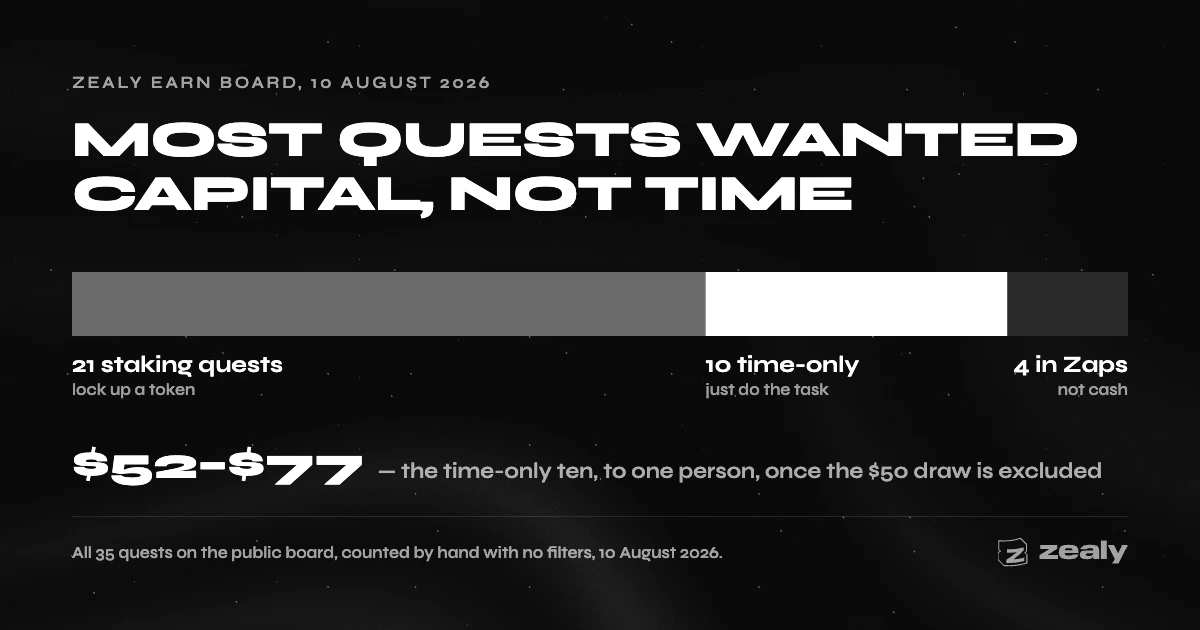
Strip them out and ten quests on the whole board asked only for time. Here is every one of them, so you can check the arithmetic instead of taking it on trust:
| Quest | Community | USDC |
|---|---|---|
| Sign Up on Website (draw, not a payout — see correction above) | Sweep Community | $50 |
| 7 Years, One Feature Worth Sharing (Tier 4) | SwapSpace | $40 |
| 7 Years, One Feature Worth Sharing (Tier 3) | SwapSpace | $30 |
| Create content and earn $20 | Ashen Throne KOL campaign | $20 |
| 7 Years, One Feature Worth Sharing (Tier 2) | SwapSpace | $20 |
| 7 Years, Now in Your Pocket | SwapSpace | $15 |
| 7 Years, One Feature Worth Sharing (Tier 1) | SwapSpace | $15 |
| Light Up Discord! | Axion DAO Foundation | $2 |
| Hop in! Community Quest 20 | Ratehopper AI | $0.15 |
| Hop in! Community Quest 40 | Ratehopper AI | $0.15 |
Excluding the Sweep quest, whose $50 is drawn between two winners rather than paid to everyone, the nine remaining quests have a median of $15 and a raw total of $142.30. That raw total still overstates what one person could collect, because the four SwapSpace tiers are rungs of one campaign and a participant qualifies for a single rung, not all four.
So the honest figure is a range, not a headline. Counting the top tier gives $77.30. Counting the bottom tier gives $52.30. Somewhere between those is what one person completing every time-only quest on the board that day would have been paid outright, plus an entry into the two-winner draw for $50.
That is the honest shape of it: a real amount of money, paid quickly, on a board small enough to exhaust in an afternoon. Treat it as a supplement. Anyone telling you a quest platform replaces a job is selling you something.
USDC you earn sits as a balance until you withdraw it to a Polygon wallet. The minimum withdrawal is $1, and claiming a reward costs nothing. Those withdrawal terms were checked in the live product on 7 August 2026 and are not yet covered by Zealy's public documentation — check the withdrawal screen for the terms that apply to you. Our full guide to Zealy covers the payout mechanics, including which rewards Zealy guarantees and which a community owes you directly.
How to tell a real earning platform from a task scam
No legitimate platform asks you to send it money in order to release money it says you have already earned. What the US Federal Trade Commission calls a task scam imitates a quest or microtask platform, then reverses the direction money flows: the app shows you a rising balance, then asks you to deposit your own funds to unlock earnings that were never real. That is the test.
It is a narrower test than "never deposit anything", and the difference matters if you spend any time in crypto. Staking a token to earn a reward is not the scam pattern: the deposit goes into a contract you can read, the position stays yours, and the reward is paid on top of it. The scam pattern is a payment to the platform itself, demanded after the fact, as the price of withdrawing a balance that does not exist.
The FTC's data spotlight Paying to get paid, published 12 December 2024, describes the mechanic: "Task scams ask you to do simple repetitive tasks such as liking videos or rating product images. Your 'job' is to complete these tasks in an app or online platform that creates the illusion you're racking up commissions with every click." The catch arrives later, when the app asks you to deposit your own money — usually in crypto — to unlock earnings that were never real.
The FTC reported that losses to job scams "increased more than threefold from 2020 to 2023 and, in just the first half of 2024, topped $220 million", with reported yearly losses of $90 million in 2020 rising to $286 million in 2023. About 20,000 people reported task scams in the first half of 2024, against about 5,000 in all of 2023. Fraud overall keeps climbing: the FTC told the Joint Economic Committee in March 2026 that consumers reported $15.9 billion in losses across 3 million fraud reports in 2025.
The FTC's consumer alert on task scams gives three tests, quoted here in full:
- "Ignore generic and unexpected texts or WhatsApp messages about jobs. Real employers will never contact you that way."
- "Never pay anyone to get paid, or to get a job. That's a sure sign of a scam."
- "Don't trust anyone who says they'll pay you to rate or like things online. That's illegal and no honest company will do it."
That third test deserves an honest note from us, because quest platforms including Zealy do pay people to perform social actions. The rule the FTC points to is its final rule banning fake reviews and testimonials, announced 14 August 2024, which prohibits "providing compensation or other incentives conditioned on the writing of consumer reviews expressing a particular sentiment, either positive or negative."
Following an account or joining a Discord server is not a consumer review. Being paid to post that a product is good is much closer to the line. If a quest anywhere — on Zealy or elsewhere — pays you to publish an opinion about a product, say plainly in the post that you were paid for it. That disclosure is what separates a paid endorsement from a fake review, and it is your name attached to the post, not the platform's.
The clean test that survives all of this: no legitimate platform asks you to send it money in order to release money it says you have already earned. Plenty of honest costs exist on the way in — Etsy charges to list, freelancing sites take a cut, a staking quest asks you to stake — and all of them are stated before you start and leave you holding something. A balance that only unlocks once you pay the platform is the scam.
Where to actually start
Pick by how soon you need the money, not by what sounds most interesting. Paid research pays within days and caps out low. Freelancing pays the most, after weeks of unpaid proposals. Quests pay small amounts quickly; cashback apps pay small amounts slowly. Building an audience pays nothing for months, then compounds. No route pays well and fast at once.
If you need money this week, Prolific has a published pay floor and a £6/$6 cash-out, which makes it the most predictable option in this article. If you have a skill someone pays for, freelance, and accept that the first month is proposals. If you want small amounts while doing something else, use quests and cashback apps with the thresholds checked first. If you are building something for years, treat early money as a bonus.
Whichever you pick, the median US side hustle — online or off — made $200 a month in 2025. Plan around that number and anything above it is a good surprise.
One place to start: open Zealy's Earn board and read the quest titles before the amounts. The titles tell you which quests pay for your time and which pay for staking a token, so you can pick the kind you want before the number next to it does the deciding.