Short answer: "Without investment" means no money in. It does not mean no cost — the cost is time, and on most platforms the time runs until a published minimum balance is reached. The honest way to test the phrase is to open a board and count. We counted ours on the morning of 18 August 2026: of the $277.05 in USDC then on Zealy's public Earn board, thirty cents was payable to everyone for a task that cost no money.
How this article is sourced. Zealy publishes it, and the count below is of Zealy's own board. That is the point of the article rather than an awkward disclosure — the phrase "without investment" is easiest to test on the platform you control. Every external threshold links to the page carrying it.
Last verified: 18 August 2026. The Earn board changes fast enough that we can show you: we counted 32 quests at about 08:25 UTC, and when we reopened the board at 10:24 UTC the same morning it held 76. Treat every figure below as one reading taken at one moment, not a rate card.
What does "earn money online without investment" actually mean?
It means the platform asks you for no money to start. It does not mean the activity is free, because two other prices are attached: the hours before any balance exists, and the minimum balance set before that money can leave. A route with no joining fee and a $20 payout threshold is not free. It is priced in time.
That reframing matters because the phrase is also the exact hook used by the thing you should avoid. The US Federal Trade Commission's alert on task scams describes apps that show a rising balance for simple repetitive work and then ask for a deposit to release it. Its rule is one line: "Never pay anyone to get paid, or to get a job. That's a sure sign of a scam." Everything below is about honest costs that are stated up front. That one is not.
The hours between free and your first withdrawable dollar
Two numbers decide how long "free" takes: what the platform pays, and the minimum balance it will pay out. Dividing one by the other gives the time cost, and the answers run from about an hour to something no number of hours reaches. The division is ours; the inputs are each platform's own.
| Platform | Published rate | Published minimum before payout | Roughly what that means |
|---|---|---|---|
| Prolific | £6 / $8 an hour enforced floor | £6/$6 combined approved balance | About an hour of studies, if studies are available to you |
| Google Opinion Rewards (iOS) | $0.10 to $1.00 per survey | $2.00 accrued, paid via PayPal | Between 2 and 20 surveys, depending on each survey's length |
| Rakuten | Not a rate; a share of purchases | $5.01 confirmed, paid every three months | Requires spending money, so not this category |
| Ibotta | No per-offer rate on the page cited | $20, one redeemed offer, and a 7-day wait | Requires buying groceries, so not this category |
| Zealy | Set per quest by the community running it | $1 is the smallest withdrawal you can request, to a Polygon wallet; a withdrawal fee is charged on top of it (product-checked 7 August 2026; fee direction confirmed in Zealy's payout code 18 August 2026) | The smallest request here, but the balance you need is above $1, and most of the board's USDC requires money in — see the count below |
Zealy's row is the one with no link, and here is how far we looked for one. Working from Zealy's sitemap on 17 August 2026, what actually arrives when an app says it pays real money opened the five documentation pages covering rewards, reward methods, Zaps, earning and billing, and the word "withdraw" appears in the visible copy of none of them — it turns up only in the cookie banner those pages carry. That is five pages, not the whole site.
Two of those rows fail the test on their own terms, and it is worth saying so rather than listing them as free options. Rakuten pays a share of what you spend and Ibotta pays against receipts, so both require money out before any money comes in. They are good at what they do. They are not "without investment".
Prolific is the cleanest pass in the table: an enforced floor, a threshold about an hour of work away, and PayPal at the end. Its limits are published too. A separate help centre page lists the countries it is open to and offers a waitlist to everyone else, with the hedge "We can't guarantee access". Prolific also applies a 72-hour cool-off between cash-outs to anyone who has recently added or updated their PayPal address or made fewer than four cash-outs, waits it says "cannot be expedited or lifted under any circumstances".
Google Opinion Rewards is the clearest illustration of why a rate alone tells you nothing. At the top of its published range, $2.00 arrives in two surveys. At the bottom, it takes twenty. Google says the amount "is dependent on the number of questions in the survey and the amount of time it takes to answer the survey", and you are not choosing which surveys arrive, so the honest answer to "how long until I can withdraw" is a range spanning an order of magnitude.
We counted our own board, and almost none of it was free
Zealy is a platform where communities post quests and pay people for completing them. At 08:25 UTC on 18 August 2026, its public Earn board held 32 quests, 29 carrying a USDC reward totalling $277.05. Twenty-one of those 29 were staking quests. We counted with no filters and every "Load More" exhausted, then opened six of the remaining eight.
$221.75 of that $277.05 sat on quests that ask you to stake a token. Twenty-one of the 29 came from a single community, IncomRWA, and their titles say so plainly — from "Stake 250 $iRWA (approx $5)" up to "Stake 300,000 $iRWA (approx $5000)". A staking quest is not the scam pattern in the FTC's sense, because the payment does not go to the platform to unlock a balance. What it does mean is that you put a token in, and you carry that token's price while you hold it. We did not audit IncomRWA's contract and this article makes no claim about it. Either way it is money in, and an article about earning without investment has to put it on the other side of the line.
That leaves eight quests and $55.30. Here is every one of them, and what the quest page added to the card.
| Quest | Community | What the card shows | What we found on the quest page |
|---|---|---|---|
| Sign Up on Website | Sweep Community | Usdc $50 | The $50 is Raffle (2) — drawn between two winners. The 250 XP goes to All. |
| Registration + Join Summer Trade 2026 + First Futures Trade ($10 minimum) | Kanga Global | Usdc $1 | The $1 is Raffle (50). The task: "Complete at least one Futures trade with a minimum margin of $10." |
| Sniper ROI: Achieve 30% ROI with $10 margin | Kanga Global | Usdc $2 | The $2 is paid to All — but only on "a minimum margin of $10" and "at least 30% ROI on a single qualifying trade" |
| Sniper ROI: Achieve 20% ROI with $10 margin | Kanga Global | Usdc $1 | Not opened. Its title names the same $10 margin. |
| Sniper ROI: Achieve 10% ROI with $10 margin | Kanga Global | Usdc $0.50 | Not opened. Its title names the same $10 margin. |
| Discord Boost & get 0.5 USDC | Amadeus Protocol | Usdc $0.50 | Paid to All. The task: "Visit and boost our discord server, submit screenshot for verification." |
| Hop in! Community Quest 20 | Ratehopper AI | Usdc $0.15 | Paid to All. Join a Telegram group and engage with posts on X. |
| Hop in! Community Quest 40 | Ratehopper AI | Usdc $0.15 | Paid to All. Same tasks, unlocked by finishing Quest 20. |
Work down that list against the phrase in the title. The $50 is a two-winner draw, so it is a lottery ticket rather than a payout. All four Kanga Global quests put $10 of your own money in the title: three as a "$10 margin", the fourth as a "$10 minimum" on a first futures trade. That is real money at real risk, and it is on the two we did not open as well as the two we did, so the arithmetic below does not turn on their reward method. A Discord Server Boost is a paid product: Discord's own Server Boosting FAQ states that "Nitro subscribers get 2 server boosts", and that if you have no available Server Boosts "you'll receive a pop-up in order to purchase a Server Boost".
What is left is two Ratehopper AI quests at $0.15 each, paid to everyone, asking only for time. Thirty cents, out of the $277.05 of USDC on the board at 08:25 UTC on 18 August 2026.
Three further quests, all from Filecoin, paid no USDC at all — they pay Zaps, Zealy's internal points, and XP. Zaps buy lootboxes, which Zealy's documentation says can hold "crypto, tokens, NFTs, or stablecoins", so they are not nothing — but they are not the dollar figure the board advertises either.
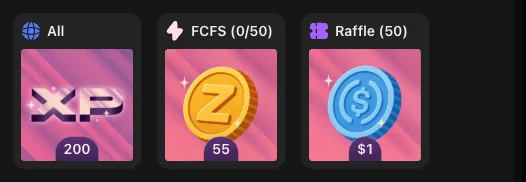
The Rewards block of Kanga Global's registration quest at zealy.io, captured 18 August 2026. One quest, three distribution methods, and the dollar is the raffled one.
That screenshot is the whole lesson in one frame. "All" means everyone who completes it gets 200 XP. "FCFS (0/50)" means the first fifty get 55 Zaps. "Raffle (50)" means the $1 is drawn among fifty. The card carried the $1 and an icon; the words above are on the quest page, and that is the screen this screenshot is from.
Read the quest page, not the card
On Zealy's Earn board, the reward amount is printed on the card in type. Whether it is paid to everyone, given to the first N, or drawn between winners is marked only by a small unlabelled icon, and named in words on the quest page. Those are different screens, and the difference is where "without investment" usually breaks.
None of this is a complaint about the communities running those quests. The gap is narrower than it looks, and worth stating precisely: the card marks the method with a small unlabelled icon — a ticket for a draw, a globe for a reward paid to everyone — and prints the amount in type. The word "Raffle" and the number of winners are on the quest page. The habit that fixes it costs about ten seconds: open the quest, read the Rewards block, read the steps, then decide whether the number on the card was ever addressed to you.
We have published this correction against ourselves before. Our guide to how to earn money online originally counted the same Sweep Community quest as a $50 payout and carries a dated correction saying so. One quest moved by $50, on a board whose entire USDC came to $277.05 at the moment we counted this one.
So what is genuinely free?
Routes priced in time rather than money, with a published rate and a low threshold. On the evidence here that is a short list: paid research on Prolific if your country is supported, surveys whose threshold is a couple of dollars rather than twenty, and the quests on any board that pay everyone for something costing nothing.
None of that is an income. It is worth saying because the phrase "earn money online without investment" attracts articles that imply otherwise, and because the honest version is still useful: a real amount of money, paid quickly, for time you were going to spend anyway. If you want the version of this arithmetic that applies to a term-time schedule and a student visa, what students are allowed to do and what it pays covers both. For the payout thresholds route by route, our guide to earning money online lists them side by side, and what actually arrives when an app says it pays real money covers the form the money takes when it finally moves.
One place to start: open the Earn board and do what this article did — pick the biggest number on it and open the quest. If the Rewards block says "All", it is addressed to you. If it says "Raffle", "FCFS", "Top" or "Vote", it is not — those go to some completers and not others. That one check is the difference between what a board advertises and what it pays.