Short answer: There are four common routes to crypto you did not pay for: completing quests or tasks, learn-to-earn quizzes, faucets, and staking. Only the first three work if you own nothing today — staking requires crypto you already hold. None of them is reliably free in the sense that matters to a tax authority: US rules treat crypto received for goods or services as income, staking rewards have their own ruling, and HMRC treats some airdrops differently again. This article is not tax advice.
Disclosure: Zealy publishes this article, and Zealy is one of the quest platforms described below. Zealy is named in the comparison, with its costs and its wallet requirement stated next to the parts that look good.
How this is sourced. Figures about a company come from that company's own terms, help centre or product page. Tax figures come from the IRS and HMRC, and fraud figures from the US Federal Trade Commission. Each is linked at the sentence it supports. Coinbase and CoinTracker return errors to automated retrieval, so those pages were opened by hand in a browser. Zealy's withdrawal terms are the one set of figures here with no public page behind them: the $1 minimum and the two-day cooldown after a wallet change were checked in the live product on 7 August 2026, and Zealy publishes neither a withdrawal fee nor a daily limit anywhere, so this article quotes neither.
This is not tax advice. The tax section quotes published guidance from the IRS and HMRC and nothing more. Your situation depends on where you live and how much you earn, and it is worth an hour of a professional's time.
Last verified: 14 August 2026. The Zealy Earn board figures, the survey of guides and the Coinbase staking rate are 12 August 2026 readings and are dated as such below.
The four routes, side by side
Four routes give you crypto without a purchase: quests, learn-to-earn, faucets and staking. They differ less in what they pay than in what they ask for first. Quests want time, and often a stake too. Binance's learn-to-earn wants verified identity. Faucets want attention. Staking wants crypto you already own, which rules it out as a way in.
| Route | Asks for first | Pays | The limit that decides it |
|---|---|---|---|
| Quests and tasks | Time, plus accounts — and often a stake | Set per quest | Most of one board wanted capital |
| Learn-to-earn | Verified identity, for new users | A fixed reward per quiz | Limited, and programmes close |
| Faucets | Attention, and ads | Very small amounts | Funded by advertising |
| Staking | Crypto you already own | A published annual rate | Cannot start you off |
On 12 August 2026 Coinbase advertised up to 1.70% APY for staking Ethereum, a rate its own page says is subject to change. Which route fits depends on what you have. If you have time and no money, quests and learn-to-earn are the two that convert effort into a balance. If you already hold a proof-of-stake asset, staking compounds it without further work.
For the wider question of what pays and how much, our guide to earning money online covers non-crypto routes as well, and our comparison of money-earning apps covers what happens to an account you stop using. This article is narrower: it only covers routes that pay in crypto and start from owning none.
What quest boards pay, and what they ask for first
Quest platforms let a project publish a task, such as joining a Discord server, posting about a launch or testing a feature, and attach a reward to it. Payouts are set per quest by whoever funds it, so they vary widely, and the reward is stated before you start. That last part separates quests from faucets.
The catch is visible on the boards themselves. We opened Zealy's Earn board on 12 August 2026 and clicked "Load More Quests" until it stopped. It held 33 quests, 30 of which paid USDC, totalling $412.05. Twenty-one of the 33 — every quest from a single project, IncomRWA — required staking $iRWA before you could claim anything, in bands the cards themselves labelled from approximately $5 up to approximately $5,000.
That leaves twelve quests needing no capital: nine paying USDC, from $0.15 up to $50, and three paying only Zaps. Four of those nine are graded tiers of a single SwapSpace campaign. The top of the board shows the split most clearly, and it was still showing it two days later.
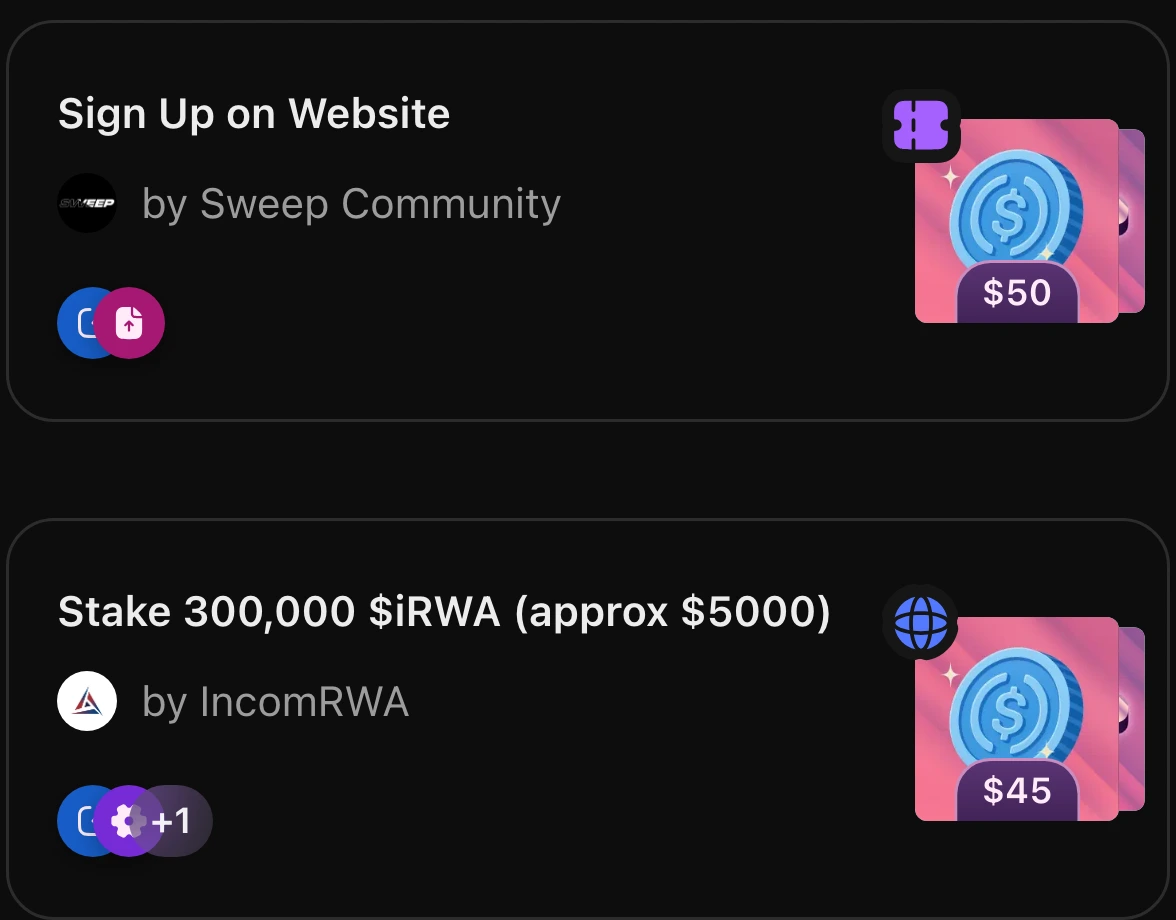
The top of Zealy's Earn board at a phone-width viewport, captured 14 August 2026. The $50 quest asks only for a signup; the $45 quest under it asks for roughly $5,000 of a token first. The counts above are from 12 August; the board changes as communities publish and close campaigns, and the same split was still visible two days later.
Correction, 16 August 2026. There is a second thing this article should have said about that top card. Opening the $50 Sweep Community quest shows its reward method set to Raffle (2) — two winners, drawn — rather than paid to everyone who completes it. We checked the rendered quest page on 15 and 16 August 2026. The card does carry the method, as a small ticket icon on the reward illustration; what it does not carry is the word or the number of winners, both of which are on the quest page. Side hustle ideas that actually pay shows both screens side by side.
So the headline number on a quest board is not a rate for your time. Read what the quest asks for, and how it pays, before you count the reward. A $50 signup quest that draws two winners and a $45 quest that needs $5,000 of a token locked up are different products sitting side by side, and the dollar figure on the card is the same size on both.
Quests suit you if you have evenings but no capital, and if you are comfortable being early to projects you have not heard of. They suit you badly if you want a predictable hourly rate, because the reward attaches to the task and not to the hour.
Learn-to-earn shrank, and the guides recommending it have not noticed
Learn-to-earn pays a small fixed reward for watching a short lesson and passing a quiz. Coinbase, which ran the version most cited in guides to free bitcoin, closed it on 27 May 2025. Binance still runs one, restricted to users it has selected, with new users required to verify their identity first.
Coinbase's help centre is unambiguous: "Coinbase Learning rewards are no longer available as of May 27, 2025. To earn more crypto, try staking your assets. We look forward to providing you with more ways to earn in the future."
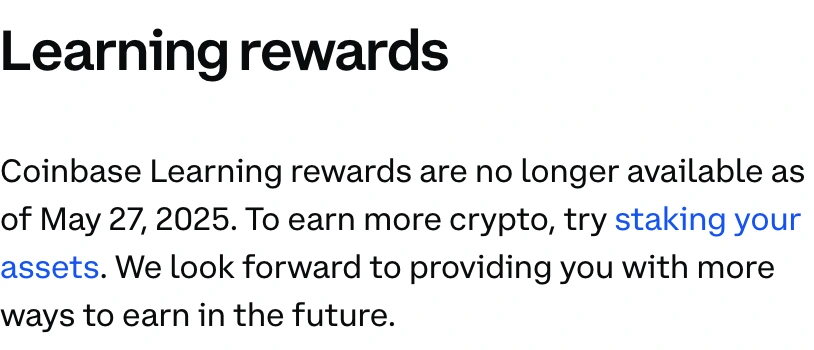
Coinbase's help centre on Learning rewards, captured 14 August 2026.
We ran a Google search for "free bitcoin" on 12 August 2026 and checked the six guides it returned to us on the first page. Search results shift by location, language and account, so this is a single sample. Four of those six still send readers to Coinbase's learn-to-earn programme.
BitDegree, whose page says it was updated on 23 April 2026, tells readers they "can find some great Learn-to-Earn programs on renowned crypto exchanges like Binance, KuCoin, or Coinbase". CoinTracker, updated 26 February 2026, describes "Coinbase Learn" as a place where "users can take video courses on various cryptocurrencies and receive free crypto as a reward". Guru99, updated 8 October 2025, carries a "Top Pick" box for Coinbase telling readers to "[e]arn crypto by learning with Coinbase Earn". BTCC describes "Coinbase's Learn and Earn program" on a page whose stated last update predates the closure.
Three of those four state update dates later than the closure: BitDegree, CoinTracker and Guru99. Only BTCC's predates it. The remaining two of the six do not send readers to Coinbase's programme: Forbes mentions Coinbase twice and never as a place to learn and earn, and Finder points its "Educate yourself & earn" section at two other apps, Yzer and Simple Bitcoin, which pay in sats to a Lightning wallet rather than through an exchange.
Binance's version shows what the limits on this route look like in practice. Its Learn & Earn FAQ says the rewards "are for targeted Binance users only", that "New users need to complete Identity Verification first" before they can earn the rewards, that "rewards are limited and are available on a first-come, first-served basis", and that "Users can only claim the reward for each course once after completing the quiz."
Read those four conditions together and the shape of the route is clear. Learn-to-earn is a marketing budget with a quiz attached, paying real money, once per course, to people the exchange has already chosen, until the budget runs out. It is worth taking when it shows up in front of you. Planning an income around it is a different proposition.
What a faucet actually sells
A faucet gives you a very small amount of crypto for solving a captcha or watching an ad, usually on a timer. The model is advertising: the operator sells your attention for more than the payout costs. On FreeBitco.in, the hourly free claim shares its opening screen with a HI-LO game, a weekly lottery and a car giveaway.
That page is worth reading as a whole. FreeBitco.in leads with "WIN FREE BITCOINS EVERY HOUR!", and seven bullets sit directly beneath it on a desktop screen. Five of them are "WIN UP TO $200 IN FREE BITCOINS", "MULTIPLY YOUR BITCOINS PLAYING HI-LO", "WIN HI-LO JACKPOTS UP TO 1 BITCOIN", "FREE WEEKLY LOTTERY WITH BIG PRIZES" and "WIN A LAMBORGHINI WITH GOLDEN TICKETS"; the other two offer a "BITCOIN SAVINGS ACCOUNT WITH DAILY INTEREST" and "50% REFERRAL COMMISSIONS FOR LIFE". Note the wording: those are amounts you can win, not amounts the site says it pays. Its footer links to a Bitcoin Casino, a BTC Dice Game, Lotto and Online Betting.
Quoted from the Internet Archive's capture of FreeBitco.in dated 3 May 2026. freebitco.in itself returned a 502 error on every attempt on 14 August 2026, so this article cites the archived copy rather than a live page it cannot check.
None of that is hidden. Every one of those lines sits in the opening screen on a desktop browser, in capitals, and the casino, dice game, lotto and betting products are named in the site's own footer. A guide that describes a faucet purely as a way to accumulate small amounts of bitcoin is describing one feature of a gambling site, and the operator is being the more candid of the two.
Zealy does not recommend faucets. This article cites an archived copy rather than the live site, because citing a source is not the same as sending readers to it.
Staking cannot start you off
Staking pays you for locking a proof-of-stake asset to help validate a network, so it requires crypto you already hold. Guides to free bitcoin list it anyway. On 12 August 2026 Coinbase advertised up to 1.70% APY for staking Ethereum, which turns a $20 balance into about 34 cents a year.
Coinbase's own page footnotes "Ability to stake subject to location and rate subject to change", so both the availability and the number move.
That arithmetic is not an argument against staking. It is an argument against the sentence "you can get free crypto by staking", which only becomes true once one of the other routes has already worked. Staking is where this list ends up, once something else has already put a balance there.
Crypto you earn is taxable income
Crypto received as payment for goods or services is income under US tax rules. IRS Notice 2014-21 says virtual currency received that way is included in gross income at its fair market value on the date received. HMRC publishes separate guidance for airdrops. This is not tax advice.
The exact wording matters, so here it is. Notice 2014-21 states that a taxpayer "who receives virtual currency as payment for goods or services must, in computing gross income, include the fair market value of the virtual currency, measured in U.S. dollars, as of the date that the virtual currency was received."
Staking rewards have their own ruling. In Revenue Ruling 2023-14, which addresses a "cash-method taxpayer" who stakes cryptocurrency native to a proof-of-stake blockchain, the IRS holds that "the fair market value of the validation rewards received is included in the taxpayer's gross income in the taxable year in which the taxpayer gains dominion and control over the validation rewards" — that is, when you can actually sell or move them, not when they are announced.
HMRC draws a sharper line, though its guidance here covers airdrops specifically and not the other routes. Its cryptoassets manual page on airdrops says Income Tax "may not apply" to airdropped tokens received in a personal capacity "without doing anything in return (for example, not related to any service or other conditions)" and not as part of a trade or business involving cryptoasset exchange tokens or mining, but that "[a]irdrops that are provided in return for, or in expectation of, a service are subject to Income Tax" (CRYPTO21250). HMRC adds that disposing of an airdropped token can still produce a Capital Gains Tax charge even when Income Tax did not apply on receipt.
So airdrops split in two under that guidance. Tokens that arrive because you did something are earnings. Tokens that arrive because you happened to hold a wallet may not be. The other routes in this article all involve doing something in return, which is why "free" is the wrong word for them — though where exactly each one lands for a UK taxpayer is a question for an accountant, not for this article.
Keep a record of the date, the amount and the value at the time for anything you receive. Doing that at $5 a time feels excessive, which is exactly why so few people can reconstruct it later.
Why the search term itself is a risk
"Free bitcoin" is a phrase scammers optimise for, and the payment method is the tell. The US Federal Trade Commission found that "[i]n 2024, consumers reported losing more money to scams where they paid with bank transfers or cryptocurrency than all other payment methods combined" (FTC, March 2025).
Our guide to earning money online works through the fraud numbers in more detail. For this article the practical read is narrow: any offer that asks you to send crypto, connect a wallet to an unfamiliar contract, or pay a fee to release a withdrawal is the shape those reports take. A genuine earning route does not need your money first.
Where Zealy sits, and what it costs
Zealy publishes this article, so this section covers Zealy's costs and not its benefits. Zealy is a quest platform paying USDC to a linked Polygon wallet. The smallest withdrawal you can request is $1. Zealy publishes neither a withdrawal fee nor a daily limit on any public page, and most quests on its board currently require capital.
Zealy does not publish its withdrawal fee or its daily limit. Read the withdrawal screen for the fee and the limit that apply to your account, because this article quotes neither: a number nobody can check against a public page is a number that goes stale silently. The $1 minimum and a two-day cooldown after you change the linked wallet were checked in the live product on 7 August 2026. Documenting the rest properly is the fix, and it is on us.
Zealy pays USDC to a Polygon wallet, not cash to a bank. That means setting up a crypto wallet and holding a stablecoin before you can be paid at all — a barrier that a survey app or a learn-to-earn quiz does not put in front of you.
Most quests on the board want capital. Of the 33 quests on Zealy's Earn board on 12 August 2026, 21 required staking $iRWA first, and the twelve that did not were mostly at the small end. For an article about earning crypto without buying any, that is the honest asterisk. It is also one day's snapshot, not a permanent feature of the board.
Our full guide to Zealy explains which rewards Zealy guarantees and which a community owes you directly, which is the other thing worth knowing before you spend an evening on a quest board.
How to check an earn-crypto offer
Three checks catch most bad offers, and they take about five minutes. Read what the reward is conditional on before you read the reward. Find the withdrawal terms before you start earning. And read the operator's own homepage, which is usually honest about what it sells.
Read what the reward is conditional on. On a quest board, a task needing $5,000 of a token and a task needing an email address print their rewards in the same size type. The number tells you nothing about the ask.
Read the withdrawal terms first. Look for the minimum balance, the fee, whether the fee is added to your request or taken out of it, the destination and the timing. Zealy publishes neither its withdrawal fee nor its daily limit on a public product page, which is a fact about Zealy and not a detail you missed. The related question — who holds a balance while it sits there, and what happens to it if the company fails — is one our guide to crypto apps for beginners works through using the companies' own terms.
Read the operator's homepage for what it sells. FreeBitco.in names its casino, dice game, lotto and betting products in its own footer, under bullets promising jackpots and a Lamborghini. Companies are usually candid about their business model on their own front page; it is the guides describing them that leave it out.
And check the date on any guide before you follow it, including this one. Four of the six pages we checked were still recommending a programme that closed in May 2025.
One place to start: Zealy's Earn board shows the reward amount on each quest card before you sign in, though the reward method is named in words only on the quest page. Read the withdrawal terms on the withdrawal screen before you count on a number.