
Short answer: Guides to beginner crypto apps compare fees, supported coins and interface quality, and the better ones explain custody. Almost none of them follows custody to its conclusion: what the company's own legal documents say happens to your balance if the company fails. On that question, Coinbase gives a clear answer in both its User Agreement and its SEC filing, and then says in the filing that no court has yet tested it.
Disclosure: Zealy publishes this article and Zealy appears in it. This is not a ranking and there is no winner. Zealy is a place to earn USDC by completing quests, not a place to buy or trade crypto, so it is not a substitute for the other apps here. Zealy's own terms are held to the same test as everyone else's, and they do not answer it.
How this is sourced. Every claim about a company comes from that company's own governing document — its user agreement, terms of use, or filing with the US Securities and Exchange Commission — and is linked at the sentence it supports. Regulator claims come from the FDIC and SIPC directly. Coinbase's site blocks automated retrieval, so its User Agreement was read in a browser.
This is not financial advice. This article is about what custody documents say, not about what to buy or whether to buy anything.
Last verified: 14 August 2026.
The question beginner guides skip
Beginner crypto guides rank apps on fees, coin selection and interface quality. Those matter for cost and comfort. None of them decides whether your balance survives the company holding it. The question that decides that is what the company's own documents promise if it becomes insolvent.
We searched "best crypto apps for beginners" on 14 August 2026 and read the six guides on the first page: BitDegree, NFT Evening, coinspot.io (a crypto news site, not the Australian exchange CoinSpot), GOBankingRates, Directions Magazine and the Bitcoin Foundation. Two of the six are not crypto publications at all: directionsmag.com is a geospatial trade magazine with a crypto section bolted on, and bitcoinfoundation.org states on its own about page that the domain has changed hands. That is worth knowing about this SERP before treating it as a field of expert sources. Search results vary by location and account, so this is one sample, not a census.
Several of them do explain custody, and one covers self-custody at length. None of them follows it to the end. Across all six pages, the words "bankruptcy", "insolvency" and "creditor" appear zero times. "FDIC" appears on one of the six and "SIPC" on none. They tell you who holds the keys. They do not tell you what happens to your balance when the company holding them fails.
That is the gap this article fills. Below, three apps of genuinely different types, checked on the same questions, each expanded with sources in the sections that follow.
| App | Who holds the keys | If the company fails | Insurance on the crypto |
|---|---|---|---|
| Coinbase | Coinbase | Cites UCC Article 8; no court has ruled | No FDIC or SIPC; private theft cover only |
| MetaMask | You | It holds nothing to claim | None applies |
| Zealy | Zealy, until you withdraw | Its terms are silent | None published |
Three different answers, and the differences are not a matter of quality. A self-custody wallet and a custodial exchange are different products with different failure modes, and the right one depends on what you are doing.
Custodial or self-custody: who actually holds the keys
Custody means control of the private key that moves a crypto asset. In a custodial app such as Coinbase, the company holds the key and your balance is an entry in its records. In a self-custody wallet such as MetaMask, you hold the key, usually as a recovery phrase. That single difference determines every other protection question in this article.
The trade is real in both directions. Custodial apps handle the security for you and can help when you lose a password. Self-custody removes the company from the equation entirely, and removes the help too.
Consensys, which makes MetaMask, puts its side plainly. Its Terms of Use define "Supported Digital Assets" as only those listed as available to interact with or self-custody in your MetaMask wallet, and warn, in capitals in the risks section, that "CONSENSYS WILL NOT STORE A BACKUP OF, NOR WILL BE ABLE TO DISCOVER OR RECOVER, YOUR PRIVATE KEY OR SECRET RECOVERY PHRASE". The staking section of its Additional Offerings appendix adds that Consensys "operates non-custodial services, including staking" and that "you and not Consensys are responsible for safeguarding the security key that controls access to your staked tokens and your rewards".
Read that warning as the price of the first line. The protection and the risk here are one fact seen from two sides: nothing can be frozen by a company that never holds it, and nothing can be restored by one either.
Coinbase's answer, and the part no court has tested
Coinbase gives the same answer in both of its documents, then says the answer is untested. Its User Agreement states that customer assets are not subject to its creditors' claims, bar one carve-out. Its annual report to the SEC names the legal mechanism, states Coinbase's belief that a court would agree, and concedes no court has ruled.
Here is the User Agreement, section 2.7.1:
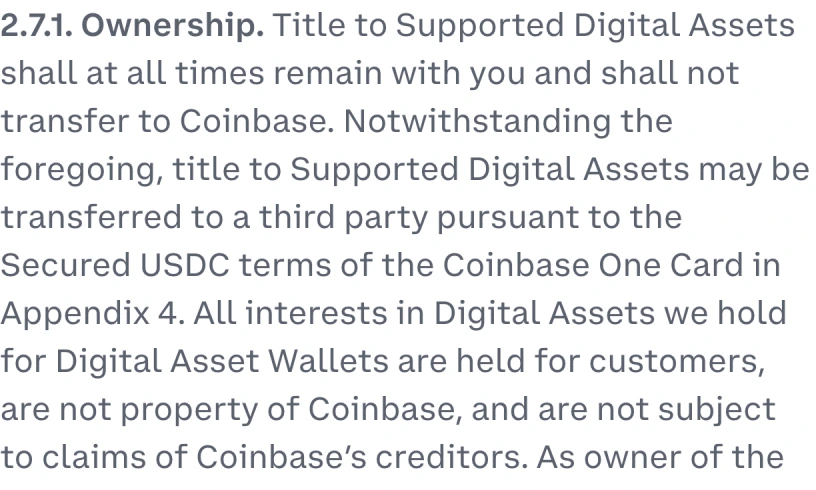
Section 2.7.1 of Coinbase's United States User Agreement, captured 14 August 2026. Note the carve-out in the second sentence: title can transfer to a third party under the Coinbase One Card's Secured USDC terms.
Read only that, and the question looks settled. The annual report Coinbase filed with the SEC on 12 February 2026, covering the 2025 financial year, is where the qualification lives. Its risk factors say that "because custodially held crypto assets may be considered to be the property of a bankruptcy estate, in the event of a bankruptcy, the crypto assets we hold in custody on behalf of our customers could be subject to bankruptcy proceedings and such customers could be treated as our general unsecured creditors":
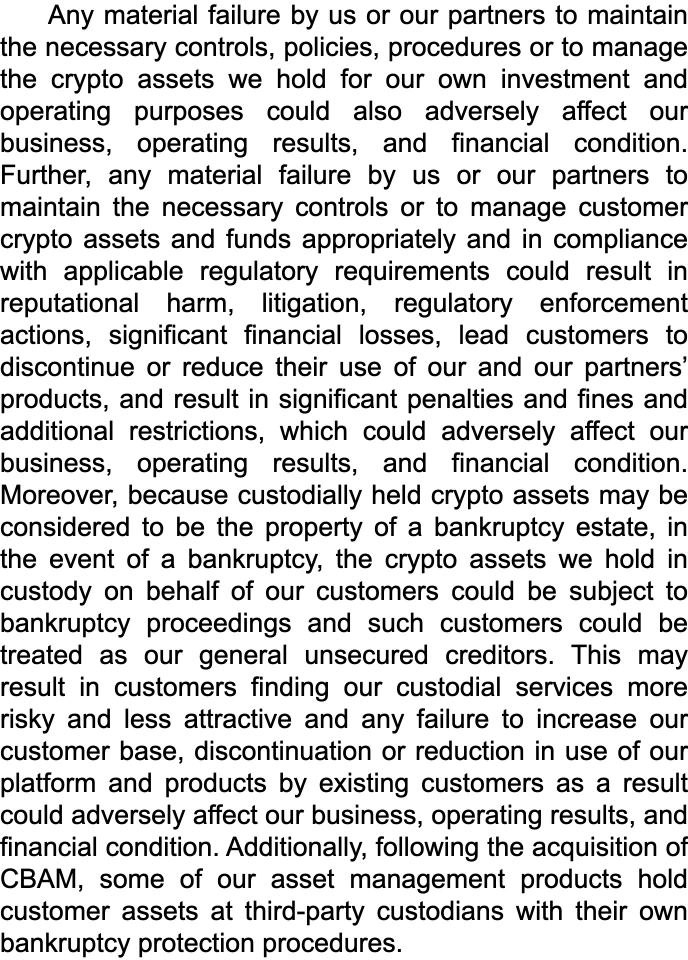
A risk factor in Coinbase Global, Inc.'s Form 10-K for the year ended 31 December 2025, filed 12 February 2026. The whole paragraph is shown, uncropped; the sentence that matters begins "Moreover, because custodially held crypto assets…". A search of Coinbase's filings on the SEC's EDGAR database returns it in the annual reports for the 2022, 2023, 2024 and 2025 financial years.
Quoted alone, that sentence reads as a contradiction of the User Agreement, and it is often passed around as one. It is not. The paragraph immediately after it in the same filing gives Coinbase's answer:
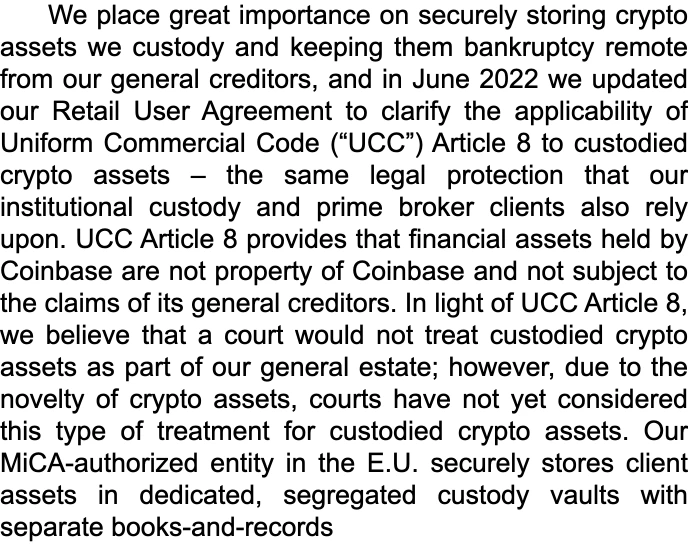
The next paragraph of the same filing. Coinbase says it keeps custodied assets "bankruptcy remote from our general creditors" under Uniform Commercial Code Article 8, which "provides that financial assets held by Coinbase are not property of Coinbase and not subject to the claims of its general creditors".
So the two documents agree. What the filing adds is the sentence a beginner actually needs: "In light of UCC Article 8, we believe that a court would not treat custodied crypto assets as part of our general estate; however, due to the novelty of crypto assets, courts have not yet considered this type of treatment for custodied crypto assets."
That is the real state of play, and it matches neither of the two things beginners usually get told. The reassuring version, that crypto on a large exchange is about as safe as money in a bank, skips the missing court ruling. The cynical version, that the exchange really owns your coins, skips UCC Article 8 and Coinbase's stated legal position entirely. What exists is a protection with a clear mechanism, a considered legal opinion behind it, and no case law to point at yet.
Credit where it is due, too. Coinbase publishes both halves of this, as Consensys publishes its own blunt warning about lost recovery phrases. A private app under no obligation to file a 10-K never has to say anything at all.
If you want the version that skips the argument entirely: assets held in a wallet whose keys you control are not part of it.
Your dollars and your crypto are not protected the same way
On a US custodial app, the cash and the crypto in the same account are protected differently. Dollars held as cash may sit in banks structured to pass FDIC insurance through to you, up to $250,000. Crypto gets no government insurance at all, though Coinbase carries a private policy against theft. Neither covers the company failing.
The FDIC's fact sheet on crypto companies, published 28 July 2022, states that "FDIC deposit insurance does not apply to financial products such as stocks, bonds, money market mutual funds, other types of securities, commodities, or crypto assets", and that "FDIC insurance does not protect against the default, insolvency, or bankruptcy of any non-bank entity, including crypto custodians, exchanges, brokers, wallet providers, and neobanks."
SIPC, which covers customers of failed brokerages, is equally direct. Its page on what SIPC protects states that "SIPC does not protect any digital or crypto asset that does not qualify as a 'security.'"
Coinbase says the same thing about its own product. Its User Agreement states that "SIPC does not apply to digital assets or cash held in your USD Wallet", and that cash in a USD Wallet sits in "pooled custodial accounts" at FDIC- or NCUSIF-insured institutions, established "in a manner to make available pass-through FDIC or NCUSIF insurance available up to the per-depositor coverage limit then in place (currently $250,000 per individual)". The same section adds that Coinbase "may also place your funds in liquid investments" such as US treasuries or government money market funds, and that "[y]our funds may be held in any one of these manners". The agreement also says plainly that "Coinbase is not an FDIC-insured bank or NCUSIF-insured credit union."
Note the conditions Coinbase attaches to that pass-through insurance. It is "contingent upon factors including Coinbase having correct information about you as a customer and maintaining accurate records, and on the determination by the relevant federal regulator as receiver, at the time of a receivership of a bank or credit union holding a custodial account". Pass-through coverage protects against a bank failing. It is not cover for the crypto, and it is not cover for the app.
The other two apps here need no such reading. The FDIC's own list of what it does not protect names "wallet providers" alongside custodians and exchanges, so a self-custody wallet such as MetaMask has no deposit insurance and no insurer to lose — there is no balance held by Consensys for anyone to insure. Zealy holds a USDC balance but is a French company, Freyja Labs, so the US deposit-insurance regimes are not the applicable ones in the first place, and Zealy publishes no protection of its own, government-backed or commercial.
Coinbase does carry insurance on the crypto, and it is worth being precise about what it covers. Its insurance page states that Coinbase and its operating subsidiaries "are covered by Coinbase Global, Inc.'s crime insurance that protects a portion of digital currencies held across our storage systems against losses from theft, including cybersecurity breaches". The same page says the policy "does not cover any losses resulting from unauthorized access to your personal or business Coinbase account(s) due to a breach or loss of your credentials", does not cover non-fungible tokens, and warns that "total losses may exceed insurance recoveries so funds may still be at risk".
That is a commercial crime policy, not deposit insurance. It covers a portion of Coinbase's storage being robbed. It does not cover Coinbase becoming insolvent, and it does not cover somebody getting into your account with your own password. Coinbase says so on the same page: digital currency "is not insured or guaranteed by" the FDIC, the NCUSIF or SIPC.
So when a crypto app uses the word "insured", find out which balance it refers to and against what. Government deposit insurance, a private theft policy and no cover at all are three different things, and only the first is what most people picture.
Where Zealy sits, and what our own terms do not say
Zealy publishes this article, so Zealy is checked on the same questions as the other apps here. Zealy is a quest platform paying USDC, which Zealy holds as a balance until you withdraw it to a Polygon wallet you control. Until that withdrawal, Zealy is a custodian. And Zealy's Terms of Use do not address custody or insolvency anywhere.
We read the Terms of Use of Zealy end to end on 14 August 2026. The page carries a date of 3 May 2023 and names Freyja Labs, a French company, as publisher, with disputes going to the French courts. It contains no section on custody, no insolvency clause, and no mention of USDC or of withdrawing a balance. The silence is not because the document predates the rewards: it names them, defining a Sprint as "a competition that is open only for leaders of a leaderboard" in which "Selected Users can earn specific rewards such as XP, cryptocurrencies or any other reward", and stating that on proven completion "Members will receive the expected rewards such as XP, and cryptocurrencies."
The two situations are not the same shape. Coinbase names a legal mechanism and tells you it is untested. Zealy names nothing. Those are different kinds of uncertainty, and only one of them is written down anywhere a reader can check.
What does follow from the product is that the custodial period ends when you withdraw. USDC on Zealy is meant to be moved to your own Polygon wallet, at which point Zealy stops holding anything and the self-custody row applies instead. How quickly you can empty a balance depends on the daily limit, which Zealy does not publish either. The practical advice is the one we would give about any custodian: do not leave a balance sitting there because you have not got round to moving it.
Writing the clause is the actual fix here, and this article does not substitute for it. Our full guide to Zealy sets out which rewards Zealy delivers itself, and how to earn crypto without buying any covers what quest boards actually pay.
How to check any crypto app in ten minutes
Four checks, in this order, on any app you are considering. Find the custody clause. Find the insolvency clause. Find what the deposit insurance actually covers. Then check the exit — the minimum withdrawal, the fee and the destination — before you put anything in.
Find the custody clause. Search the terms for "custody", "custodial" and "title". A self-custody wallet will say it cannot access your keys. A custodial app will say it holds assets for your benefit. Both are legitimate; you just need to know which one you are using.
Find the insolvency clause. Search for "bankruptcy", "insolvency" and "creditors". A self-custody wallet will have nothing to say here, which is the correct answer for that model rather than a gap. If the company is listed in the US, read the risk factors in its most recent annual report on the SEC's EDGAR database as well, because that is where a company tells investors what it tells customers less loudly. If both documents exist and disagree, that is worth knowing.
Check what "insured" covers. FDIC insurance covers deposits at failed banks, not crypto and not a crypto company failing. SIPC does not cover crypto assets that are not securities. If an app uses the word "insured", find out which balance it refers to.
Check how money gets out. Minimum withdrawal, fee, destination, and how long it takes. Our comparison of money-earning apps works through the dormancy and payout terms of seven of them, which are the same class of clause and just as easy to miss.
If the terms are silent on all four, you have learned something anyway. That is how we ended up writing the Zealy section above.
One place to start: open the terms page of whichever app you are already using and search it for the word "creditors". Ten minutes, and you will know something about it that no listicle told you.