Short answer: Growing a crypto community from zero runs in phases, and the phases have measurable lengths. Signups and first activity land inside a week, the first few hundred members inside two, a second acquisition source inside a month, and a repeating cadence from month two. The phase that decides whether you have a community rather than a mailing list is the one after the rewards stop.
What this post will not do: predict your member count. Every figure below comes from a Zealy case study that states its own window and its own starting point, and those windows run seven days, two weeks, one month, two months, eight weeks — different campaigns, different clocks. Nothing has been averaged or laid over one calendar, because that would invent a sequence nobody ran.
Disclosure: Zealy publishes this post and Zealy sells the questboard used in every campaign cited in it. Each number links to the case study it comes from, and where a case study leaves a denominator, a budget or a starting size unpublished, this post says so at the point it would have been useful.
Last verified: 14 August 2026, with the anti-cheat, rate-limiter, captcha and volume-cap claims rechecked against Zealy's source on 17 August 2026 and corrected where they were wrong.
The whole sequence in one table
Each phase of a community launch is set out below against a Zealy campaign that actually ran in that phase's window, with the starting point and spend exactly as the case study states them. The windows are different lengths on purpose, and no project has been forced onto a shared calendar. Where a figure is unpublished, the table says so.
| Phase | Campaign | Window | Starting point | Spend | Published result |
|---|---|---|---|---|---|
| Week zero | Galactic Crows, pre-launch | 3 months | existing social media audience | not stated | "low reach, engagement, and conversion" |
| Week one | Margo Cunego, Boost ton Biz | 7 days, before launch | new questboard | not stated | 7,700 signed up, 4,500 active on Discord, 10,000+ tasks finished |
| Weeks 1–2 | Stay Still 2 | 2 weeks | 0, new questboard | not stated | 500+ members, 31% sprint participation, +17% wishlist growth |
| Weeks 1–2 | Get Heavy Simulator | 2 weeks | "over 5 million visits", not a cold start | no ad spend, but Robux prizes | +2,200 players, 31% completing at least 3 quests |
| Month 1 | Relative | 1 month | 0, open beta launch | not stated | 7,500+ wallets connected |
| Month 1 | Kyoto Blockchain × Qorpo | under 1 week | not stated for either community | not stated | 10,000 members across both |
| Months 2+ | Cross the Ages | recurring monthly | 0, new Zealy community | not stated | nearly 15 quests per user per month |
| After the sprint | Stay Still 2 | 2 months | 500 at the 2-week mark | not stated | 1,500 members, 49% still completing quests with no sprint running |
One number is deliberately missing from that table. Star Atlas ran a Zealy campaign in which daily mentions on X increased 7X and generated over two million impressions in the first two weeks — the best two-week result in the set until you check the starting line: more than 300,000 X followers and over 190,000 Discord members before it began. That is what two weeks looks like with an audience already in hand. A contrast, not a template.
Only one campaign in the table says anything about budget, and what it says is that no advertising was bought. Stay Still 2, Margo Cunego's Boost ton Biz challenge, Relative and Cross the Ages each state a result without stating what it cost, so no cost figure appears anywhere in this post.
Week zero: the three months that produce nothing
Week zero is the phase you can skip in hindsight and never in practice. Galactic Crows, the studio behind Stay Still 2, spent the first three months of its pre-launch campaign working its existing social media audience, and Zealy's own case study records the outcome plainly: "low reach, engagement, and conversion."
The useful part of that sentence is the three months. Not "organic posting doesn't work", but "organic posting didn't work for a full quarter, and nobody could tell from inside it."
There is a blunter version in Zealy's community interviews, from a founder describing a launch that stalled: "We managed to get to 200 members but because of the lack of focus, we failed." Two hundred members is not a bad number. It is a terrible thing to have without a reason for people to be there.
What separates week zero from week one is a date on the calendar rather than a change of channel. Three campaigns below ran against a dated event — Stay Still 2 against a sprint, Margo Cunego's community against a challenge with an announced start, Cross the Ages against its first sprint. If you are weighing paid reach at this stage, we have priced three creator campaigns on X rather than guessed at it.
Week one: signups, then activation, then completion
Week one is three events in order, not one: people sign up, some show up somewhere they can talk, and a smaller group finishes something. Margo Cunego's Boost ton Biz challenge produced all three in seven days, before the challenge officially began: 7,700 signed up, 4,500 were active on Discord, and they finished more than 10,000 tasks.
The middle number is the one most launches never have. Plenty of projects produce signups; far fewer can point at a room where the signups turned into presence, and Discord is where that happened here. A signup is a row in a table. A person posting in Discord on day three is the first evidence that anything real is being built.
Read the clock too. All of that landed before the launch, which puts week one ahead of your start date rather than after it.
The caveat is unavoidable. Margo Cunego was not an unknown when she opened that questboard, and Zealy's case study does not split the 7,700 into people who already followed her and people who did not. Take the sequence as evidence of ordering, not as proof that a cold account produces 7,700 of anything in a week.
Weeks one to two: the first number you can be held to
Two weeks is the first window where a questboard produces a figure worth defending. Stay Still 2's questboard went from nothing to over 500 community members in two weeks, and 31% of those members took part in the sprint. Get Heavy Simulator added over 2,200 players in the same two-week window without spending any money.
Those two weeks also moved something outside the questboard: over 127 Steam wishlist saves, reported as +17% wishlist growth. The case study never prints the total those saves grew from, so +17% is quotable and the total behind it is not.
Get Heavy Simulator's two weeks carry a bigger asterisk: the game already had over 5 million visits on Roblox. That is not a cold start. It is still a clean measure of what a questboard adds to an audience you already have — 2,200 new players, 1,900 new likes, 1,900 favorites and 18,500 new visits, with 31% of those members engaging actively and completing at least 3 quests on average. The case study calls this "without spending any money", and no advertising was bought, but the sprint did pay Robux prizes to its top finishers. The first-1,000-users post takes that apart.
Both campaigns land on 31%, and the coincidence needs naming before someone turns it into a benchmark. Stay Still 2's 31% is sprint participation. Get Heavy Simulator's is active engagement at three or more quests. Two definitions meeting at one number across two unrelated projects is a sample of two, not a rule about crypto communities. The arithmetic of getting that cohort in the door — and telling a real early user from a farmed one — belongs to getting your first 1,000 users.
Month one: the second acquisition source
A month is long enough for a second acquisition source to matter, and the one Zealy publishes with the largest single-week figure is a partnership. Relative connected over 7,500 wallets in a month from an open beta launch, and a Kyoto Blockchain and Qorpo partnership quest grew two communities by a combined 10,000 members in under a week.
Neither community's starting size is published, and the case study's own results section describes those members as having "transferred between the two communities" rather than newly acquired.
That gap decides how the number can be used. Ten thousand in under a week is real, and it says nothing about a project with nobody to trade. A partnership multiplies the audience you have, and multiplying zero is still zero.
Relative's number has its own boundary: over 7,500 wallets connected. A connection is a signature, not a purchase and not a transaction, and the case study does not claim otherwise. What on-chain activity costs to produce, and how much of it the reward manufactures, is a separate post with its own uncomfortable disclosures.
Cross the Ages adds a third shape: over 2,000 players joined its new Zealy community in the first sprint, each completing what the case study calls double-digit quests. Vague in the source, so left vague here.
Months two and on: a cadence, not a campaign
After the launch window, growth stops being an event and becomes a schedule. Cross the Ages runs a recurring monthly cadence on Zealy, and its members complete nearly 15 quests each per month on average. Relative's questboard logged more than 92,000 quest claims from more than 8,000 users attempting a quest across eight weeks.
Notice what the metric becomes. In week two the number is members. By month two it is quests per user per month, because a member count only ever goes up and tells you nothing about whether anyone is still there. Nearly 15 quests per user per month is a rhythm: roughly one thing to do every other day, without a launch to hang it on.
Cross the Ages also reports an average of 12,500 views per tweet during that cadence. That is the half of the loop most sequences skip: a community with something to do every month produces social proof as a byproduct, and it feeds the next month's signups.
The phase nobody writes about: the week the rewards stop
The number almost nobody publishes is what a community does when there is nothing to win. Stay Still 2 reached 1,500 members at the two-month mark, and 49% of users were still completing quests with no sprint running. That is the phase the channel lists leave out, and the only one that says whether you built a community.
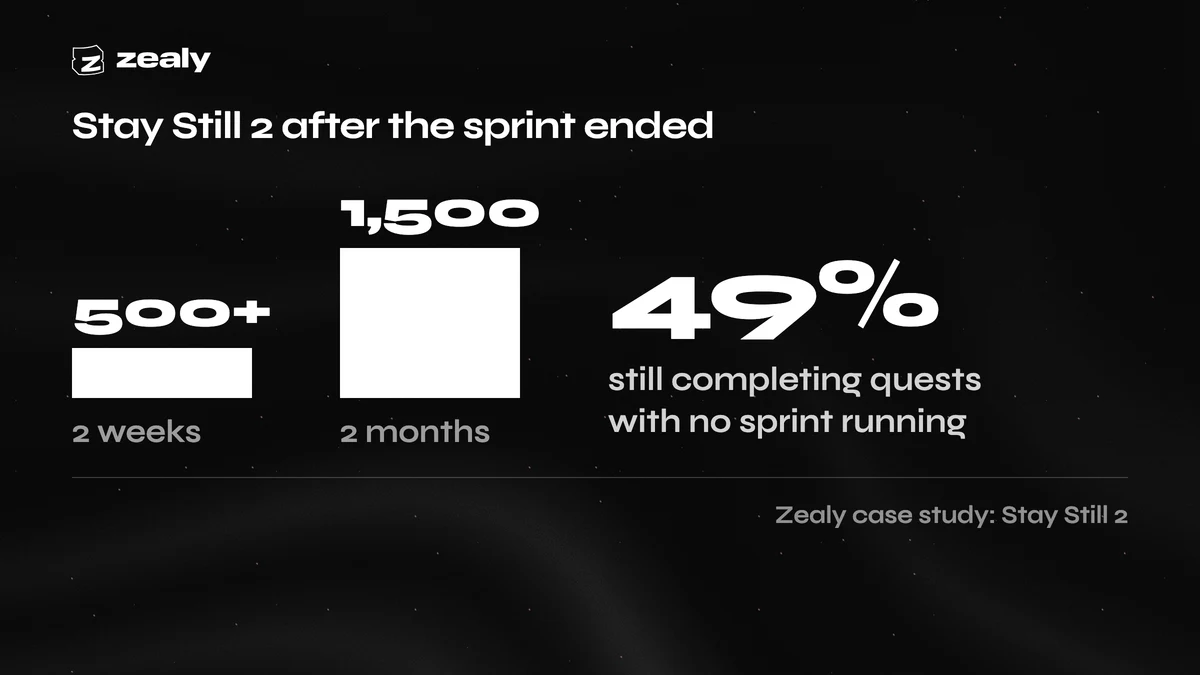
The only two membership figures Stay Still 2's case study publishes, drawn to scale. Nothing was published about the weeks in between, so nothing is drawn there.
Every other figure here measures behaviour with an incentive switched on. The 49% is the only one measured with it switched off. Search results for growing a crypto community hand you a channel list, a posting frequency and an instruction to be authentic, and none of them say what happens on the first Monday after the prize pool empties.
Be precise about what it says, though. The case study words it as "49% of users" and never defines whether that denominator is the 1,500 members, the subset who ever completed a quest, or something else. The direction survives either reading — about half of an active base kept going unprompted — but the exact claim does not.
Zealy's data does not explain why they kept going, and we are not going to invent a reason. What the evidence supports is narrower: the projects still producing activity months in were the ones running a cadence, like Cross the Ages at nearly 15 quests per user per month. A sprint is an event; a cadence is something a person can form a habit around. If your plan for month three is another sprint, you are planning to buy the same members twice.
What a "member" has to mean for any of this to count
None of these numbers mean anything if the members are one person with forty accounts. Zealy's community security settings are short: visibility, a minimum XP requirement, invite consumption, and required connections like email, wallet, Discord, X, X Premium or Telegram. Nothing in that panel detects sybils. Zealy runs one control you do not configure: a platform-wide anti-cheat score that links accounts sharing a canonical email, a connected social identifier or a verified wallet address, and temporarily restricts an account once enough of those linked accounts have claimed. It catches recycled identifiers, not one person running genuinely separate accounts, and pretending otherwise would make everything above useless.
What exists is narrower and worth configuring: a Proof of Humanity task that judges a member's Zealy profile and connected X account — it wants an avatar, a name and an email, and rejects an X account following fewer than 50 accounts or followed by fewer than 10 — though it does not read the member's quest activity — a manual review queue where a reviewer sees a member's star and flag history before approving anything, and duplicate-submission handling, which is a per-task setting on X reply and quote-tweet tasks that defaults to off, plus a reviewer-facing duplicate alert gated on a per-community flag — both of which catch identical text rather than identical people. Set the required connections before your first sprint, because a leaderboard is far harder to clean than to gate.
On this specific job — deciding whether two accounts are two people — Galxe is better than Zealy. Galxe publishes a documented bot-identification system that reads on-chain wallet signals, and sells an Advanced Sybil Prevention tier on top of it; Zealy has nothing that reads a chain. If your community is gated on a reward large enough to be worth farming, weigh that before you pick a platform. The full accounting of what Zealy does and does not detect sits in the two posts either side of this one: the first 1,000 users for cohort quality, driving on-chain activity for the wallet-level version. Read whichever matches the number you are being asked about, then come back and run the sequence.