Short answer: You get the first 1,000 real users for a crypto app by borrowing an audience that already exists and giving it one specific thing to do, inside a stated window. Zealy has published six community campaigns naming a cohort size and a window: one reached 7,700 signups in seven days, another reached 2,200 players with no advertising spend. None of them proves those were 1,000 distinct humans, and the second half of this post is about why that gap matters more than the headline.
No cost per user here. Five of the six campaigns below publish no budget, and dividing a cohort by a budget nobody printed is how most numbers in this category get made.
Disclosure and dating: Zealy publishes this and Zealy sells the questboard product used in every campaign cited. Every first-party number links to the case study it came from. Five other Zealy case studies contain figures that do not reconcile with the rest of their own page, and one section names every one of them.
Last verified: 14 August 2026, with the anti-cheat, rate-limiter, captcha and volume-cap claims rechecked against Zealy's source on 17 August 2026 and corrected where they were wrong.
What counts as a real user, and what Zealy's numbers do not prove
A real user is one person, once, doing something they would plausibly have done without the reward. Zealy cannot certify that. Zealy restricts accounts that reuse identifiers — a shared email, social account or wallet — but nothing in it separates two genuine identities, so every cohort figure in this post counts accounts, signups and claims rather than verified humans. Read them as ceilings on your real cohort, never as the cohort itself.
The airdrop record shows what happens when the reward is large and the check is weak. LayerZero counted "almost 6 million unique wallet addresses" interacting with it and offered self-reporting sybils 15% of their intended allocation (LayerZero, 3 May 2024); Cointelegraph reported "a total of 803,093 addresses were identified as potential sybil addresses," refined from over two million (18 May 2024). In one Arbitrum operation, DL News reported, "one attacker used a wallet to fund over 1,000 accounts" (5 June 2023). One person, a cohort the size of the one you are building.
So what does Zealy check? A Proof of Humanity task reads a member's Zealy profile and connected X account: it wants an avatar, a name and an email, and it rejects an X account following fewer than 50 accounts or followed by fewer than 10 before a model passes over the account. It does not read the member's quest activity. Community security settings are a short list: visibility, a minimum XP requirement, invite consumption, and required connections (a connected wallet, Discord, X, X Premium, Telegram, a pasted wallet address where the community's blockchain has no supported wallet connection, and an email requirement that the page no longer shows a toggle for but that still blocks claims where it is set). No sybil, blocklist, captcha or IP field is in it. X-task claims can sit behind a Cloudflare Turnstile check, though only on the communities where it is switched on, and it does not gate every claim. The rate limiter caps claims per community rather than per person. Platform-wide, an anti-cheat score links accounts sharing a canonical email, a connected social identifier or a verified wallet address and temporarily restricts an account once enough of those linked accounts have claimed — which catches one person recycling identifiers, and not one person running genuinely separate accounts.
Galxe publishes more here than Zealy does, including a documented bot-identification system that reads on-chain wallet signals and a paid Advanced Sybil Prevention tier. If wallet-level filtering is what decides your platform choice, that points at Galxe rather than Zealy, and how to drive on-chain activity sets out both sides of that in full.
None of which means the cohort figures below are worthless. It means they are counts of accounts, and you should size your expectations to that. Plan the campaign as though some share of the number is one person with several logins, because on the evidence above, some share of it is.
Six Zealy campaigns, and what each first cohort actually cost
Six Zealy case studies publish a community cohort size against a stated time window. Exactly one of them states its spend, and that spend is zero. The other five publish no budget, which is the largest gap in this evidence and the reason no cost-per-user figure appears anywhere in this post.
| Campaign | Starting base | Window | Cohort delivered | Published spend | Engagement published |
|---|---|---|---|---|---|
| Stay Still 2 (Galactic Crows) | zero — new questboard | 2 weeks | "over 500 community members" | not stated | "31% of members participated in the sprint" |
| Get Heavy Simulator (Roblox) | "over 5 million visits" — not a cold start | 2 weeks | "+2'200 new players" | "without spending any money", but see below | "31% of these members engaged actively", "at least 3 quests on average" |
| Margo Cunego | zero | 7 days, pre-launch | "7700 people signed up", "4500 of them were active on Discord" | not stated | "more than 10,000 tasks in just 7 days" |
| Cross The Ages | zero — new Zealy community | first sprint | "over 2,000 players" | not stated | "double-digit quests"; "nearly 15 quests" per user monthly on the recurring cadence |
| Relative | zero — open beta launch | 1 month; 8 weeks | "over 7,500 wallets" connected | not stated | "more than 92 000 Quest claims with more than 8000 users attempting a Quest in the 8 weeks" (Relative's co-founder) |
| Kyoto Blockchain × Qorpo | not stated for either community | under 1 week | "10,000 community members" across the two combined, worded elsewhere on the page as members "transferred between the two communities" | not stated | not stated |
All figures are Zealy first-party data from the six linked case studies, quoted as those pages word them.
Read the second column before the fourth, and treat the fifth with suspicion. Get Heavy Simulator looks like the cheapest result here and it is the least transferable, on two counts. A Roblox game with over five million visits behind it is not a cold start. And the zero-spend claim does not survive its own page: the sprint awarded 1,000 Robux to each of the top eight finishers, plus 1,000 Robux for two random contributors. The page prints no total and its wording does not settle whether those two shared one prize or took one each, so no total is computed here — but a prize pool is a cost, and "without spending any money" means no advertising spend. It is Zealy's sentence, on Zealy's page, and this post is about checking exactly this kind of sentence, so it gets checked here too. Stay Still 2, Cross The Ages and Relative did start at zero and landed on 500+, 2,000+ and 7,500 over their stated windows, but the units are members, players and wallet connections, so the spread across them ranks nothing. The Kyoto Blockchain × Qorpo partnership quest publishes a combined 10,000 with no starting size for either community, and its own results section calls those members "transferred between the two communities" rather than newly acquired — so it says a partnership quest moves a large number between two existing audiences, and nothing about the multiple.
Margo Cunego's campaign publishes the cleanest sequence in the corpus because it separates the steps instead of collapsing them: 7,700 signed up, 4,500 of those were active on Discord, and the group finished more than 10,000 tasks, all before the challenge officially began. Three stages with three separate denominators, which is what makes the drop-off between them legible.
For contrast, Star Atlas saw daily mentions on X increase 7X in its first two weeks on Zealy, starting from more than 300,000 X followers and over 190,000 Discord members. Good result, not a first-cohort result.
The channels that failed, and the founder who said so
Galactic Crows spent the first three months of the Stay Still 2 pre-launch on its existing social media audience and reported low reach, engagement and conversion. Wiktor Grzyb's first attempt at a Polish DAO reached 200 members and stopped. Both are published on Zealy's own site, and at the start they are worth more than the wins above.
The Stay Still 2 page states it plainly: "For the first three months of their pre-launch campaign, Galactic Crows used their social media audience to talk about the game," and "they still ended up with the same results - low reach, engagement, and conversion." Three months is the number to sit with. The questboard that followed reached over 500 members in two weeks. Two things changed, and only one of them is the questboard: Galactic Crows gave its audience something to do rather than something to see, and Zealy announced the launch to its own X account of over 160,000 followers — an audience the case study puts at 17 times the size of the studio's. Neither phase publishes a budget; the page says only that the studio had a limited one. Read the two weeks as a questboard plus a megaphone, because that is what it was.
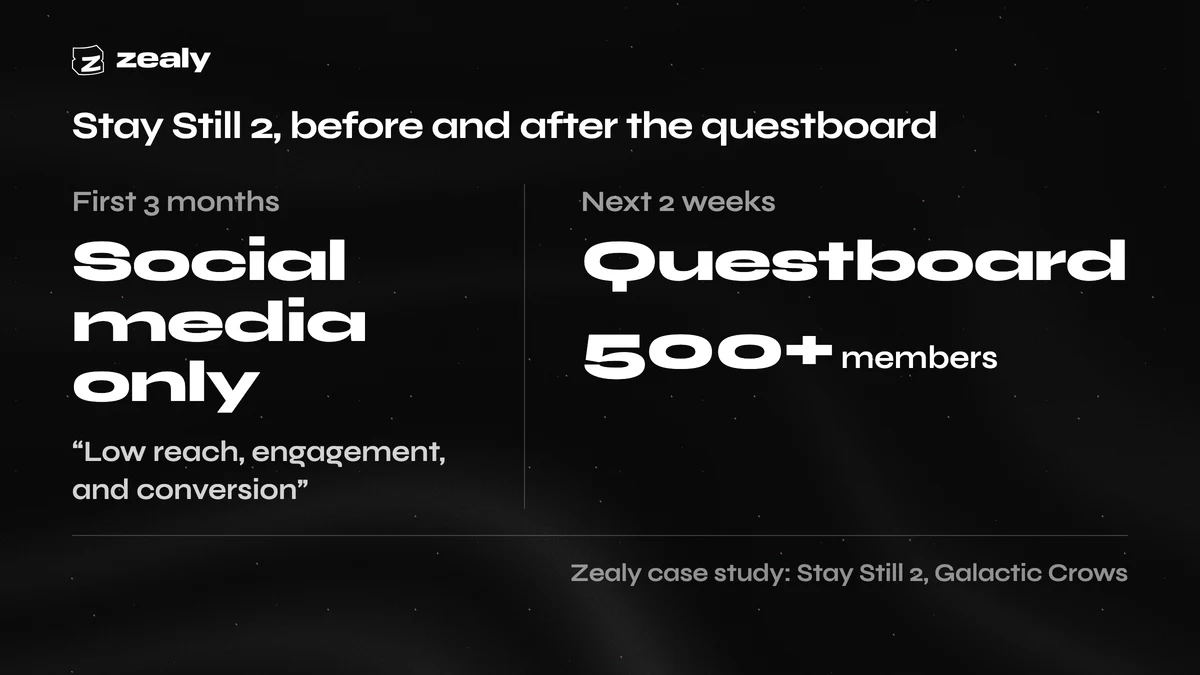
Both halves are from the same Zealy case study: Stay Still 2, by Galactic Crows. Neither phase publishes a budget, and the second was amplified by Zealy's own 160,000-follower X account.
The second failure is a founder's own verdict. In a Zealy interview, Wiktor Grzyb of Web3 Devs Poland describes an earlier project: "We managed to get to 200 members but because of the lack of focus, we failed." The diagnosis is worth sitting with: he does not blame reach, budget or the choice of channel. He blames not having decided what the community was for.
The quieter failure is silence. Zealy has published 94 community interviews, and most of them report growth without a single number — "we grew tremendously" and variations of it. Those pages are not evidence, ours included. The pattern holds across the category: the pages currently answering "how do I get users for my crypto project" are agency and generic SaaS growth posts, and not one distinguishes a real early user from a farmed one or publishes a spend figure against a cohort.
Check the arithmetic on any vendor's case study, starting with Zealy's
Take the spend and the outcome printed on the same page and do the division yourself. If the headline per-unit figure does not come back, ignore the headline. Several Zealy case studies fail that test against their own published numbers, and none is corrected at the time of writing. The test is worth more than the corrections.
Does the per-unit figure reproduce? Zealy's own KOL case study prints a cost per 1,000 views that the spend and reach on the same page do not produce. The page states $525 in spend and 100,000+ views. $525 ÷ 100,000 × 1,000 = $5.25, and because the reach is published as a floor, $5.25 is a ceiling. The headline figure reproduces from nothing on the page, so it is unusable. Raid Arena's page has a variant of the same problem. Its results reconcile cleanly — five posts at $100 USDT each, $500 total, $5 per 1,000 views — but a paragraph elsewhere on the page quotes a different per-post price entirely, carried over from another campaign. One page, two prices, and only one of them produces the total.
Is there a denominator? A percentage without the quantity it is a percentage of is not a result. NFT Paris reports a share of conference attendance, and the only attendance figure on the page — a rise from 800 to 20,000 across three editions — is a multi-year trajectory rather than the head count of the edition that share refers to. Michelin reports a whitelist percentage and a quest count with no time window and no community size. This applies to a number used above: Stay Still 2's page reports "over 127 saves, representing +17% wishlist growth," and the wishlist total behind that +17% is nowhere on it. So +17% is quoted here exactly as the page words it, and no wishlist total is back-derived from it. Neither should you derive one.
Is the return measured or estimated? TokenForge's case study states an ROI multiple its own comparison table does not support, and neither figure is a measured return: both rest on an estimate of what the work would have cost through traditional KOL deals. An estimate divided by a spend is a hypothetical. The same page carries the one piece of arithmetic in this set that checks cleanly: 25 approved posts at $10 each, total spend $250.
A borrowed benchmark is not your result either. The Stay Still 2 page compares its 31% participation to a third-party 2023 TikTok benchmark, and the Cross The Ages page quotes a mobile-stickiness range from a third-party analytics source. Zealy measured the 31%. Zealy did not measure the comparison.
This does not make case studies useless, only the unchecked ones. A page that prints its spend, window, starting base and denominators is doing something a competitor cannot fake, and you can verify it in ninety seconds with a calculator.
Set the four numbers before you run the campaign
Write down the starting base, the window, the spend and the participation denominator before the first quest goes live. Every Zealy case study that survives the arithmetic has all four; every one that fails is missing at least one. A denominator cannot be reconstructed afterwards, which makes this a pre-launch decision rather than a reporting one.
1. Starting base. Record what existed on day zero, including the audience you are about to borrow. Get Heavy Simulator and Stay Still 2 both ran two-week Zealy campaigns; one had five million visits behind it and the other had a blank questboard, and no comparison between them survives without that column.
2. Window. Zealy's usable case studies all name one, from seven days to eight weeks. "Growing fast" is not a window and compares to nothing.
3. Spend, including the reward pool. Only two Zealy campaigns publish a non-zero budget alongside a cohort, and both are MEXC listing campaigns: RIZE with a $250 USDC daily reward pool and "300+ unique traders" over 20 days, and $WALLET with $9,800 USDT and roughly 200 daily active traders over 28 days. Both cohort counts are MEXC-reported exchange data, not independent observation. And notice what both pages lead with: the volume, not the people. When the reward is paid on a metric, the metric is what gets reported.
4. Participation denominator. "31%" means nothing until you say 31% of what. Stay Still 2's 31% is of its 500+ members; Get Heavy Simulator's 31% is of its 2,200 new players. Identical headline percentage, cohorts of very different sizes. The Stay Still 2 page also reports that at two months "49% of users are still accomplishing quests even without an ongoing sprint" against a community of 1,500, and the denominator there is just "users": a good number on a soft base, the most common defect in this genre.
RIZE's page is worth one last mention for what it discloses rather than what it claims: "Volume caps enforced per hour and per user to limit abuse" were part of the campaign design. That is a vendor publishing its own anti-farming control inside a marketing case study, and it is the standard to hold any vendor to, including this one. What those caps do and do not stop is covered in how to drive on-chain activity.
Where you go next depends on what you are short of. If you have a cohort and need it to stay, how to grow a crypto community from zero walks the week-by-week sequence, including what happens after the rewards stop. If you need the borrowed audience first, what reach on X costs prices three Zealy creator campaigns with the budgets published.