Short answer: Most "free backlink" lists for crypto are lists of nofollow profile links. Only a handful of free sources give you a dofollow link from a trusted, relevant domain — realistically: an ecosystem or grant page, a genuine guest post, a journalist quoting you, and a human-reviewed editorial feature. This guide ranks all 15 by what they actually do, and it starts with one we control: if you run a real community on Zealy, you can ask us to feature you, and the link we publish is dofollow.
Disclosure: Zealy publishes this article and ranks itself first. We've spelled out exactly what our link is, what it isn't, and how the review works, so you can judge the claim rather than trust it. Everything on this page about Zealy's own markup is verifiable in our source code and in a browser's inspector.
Last verified: July 2026.
How we ranked these
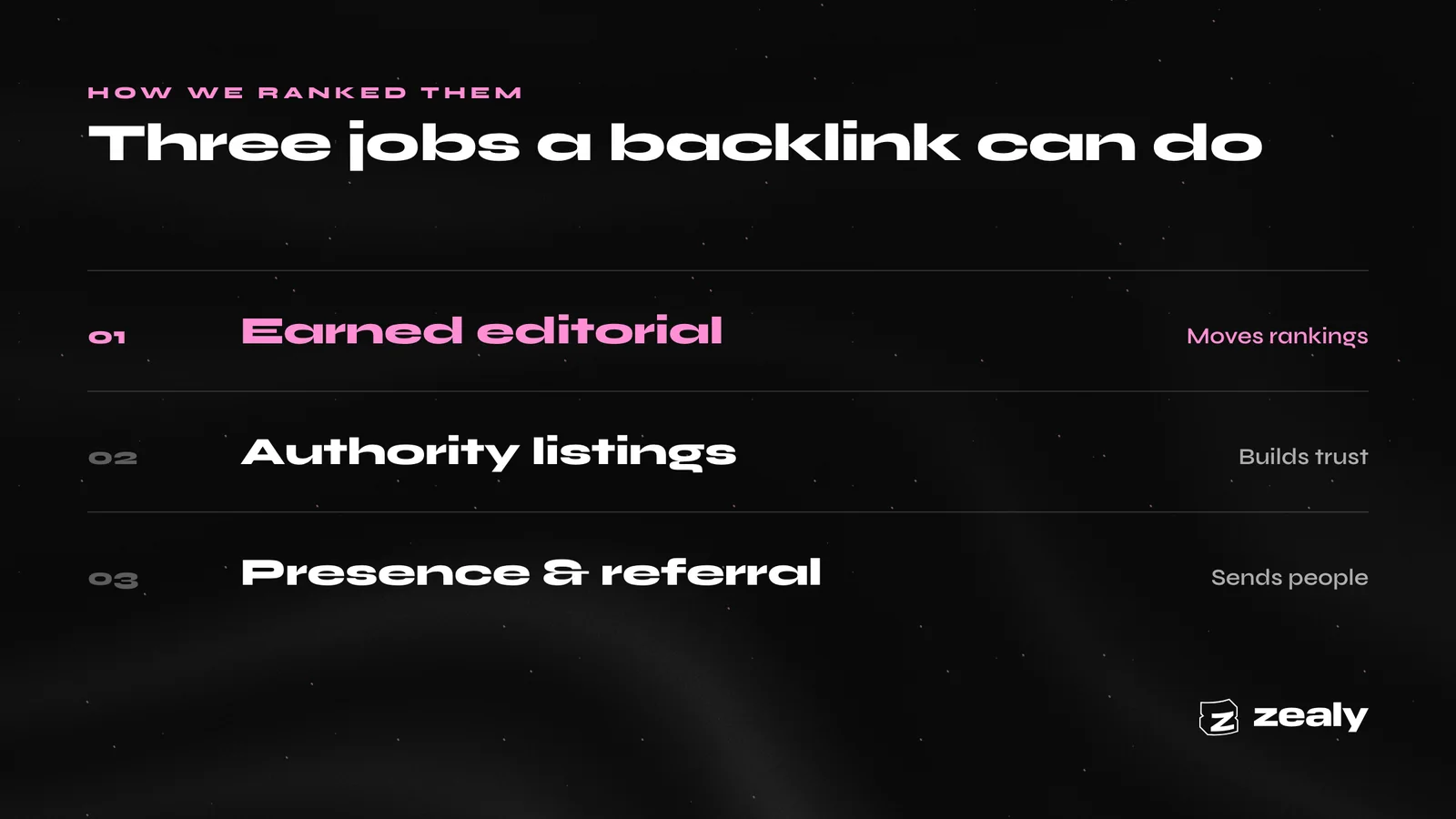
Five questions, in this order: Can you get it without paying? Does it pass ranking signals? Is the host trusted and topically relevant? How long until the link is live? Does it compound into more links?
That order matters, because it reshuffles the usual list. CoinGecko is a more valuable asset than a small ecosystem page — but its outbound links are nofollow, so it can't move rankings on its own. We've been honest about which is which.
Dofollow, nofollow, ugc, sponsored
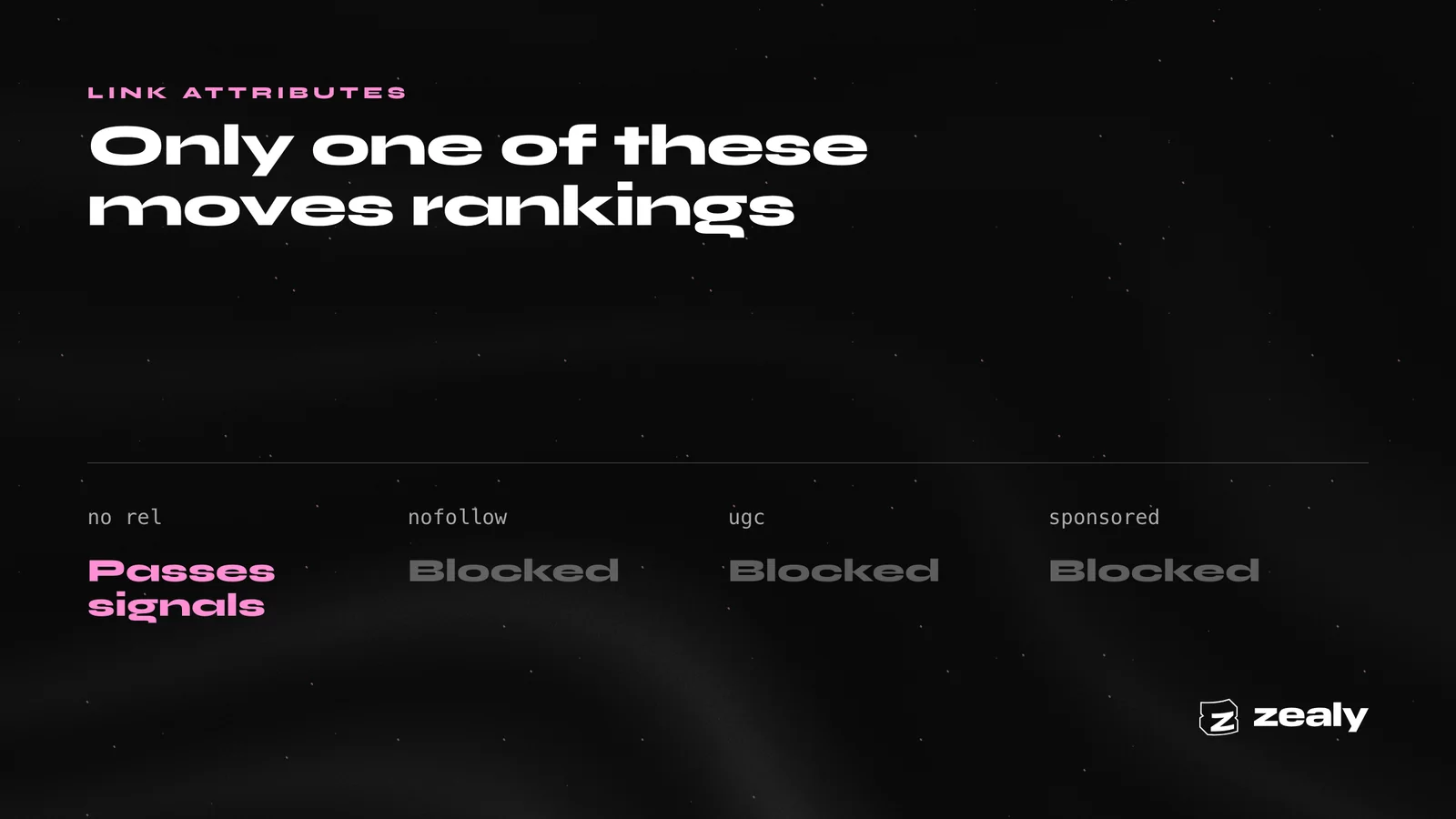
A link passes ranking signals only when it carries no rel attribute. nofollow, ugc and sponsored all tell Google not to pass credit — Google documents each value in Qualify your outbound links to Google. Its spam policies are blunt about the boundary: "Buying or selling links for ranking purposes" is a violation, and "It's not a violation of our policies to have such links as long as they are qualified with a rel="nofollow" or rel="sponsored" attribute value."
So a nofollow link isn't a failure. It still sends referral traffic, gets your pages discovered, and keeps your link profile looking like a real company's rather than a bought one. It just won't lift you in the SERP by itself.
How to check any link yourself: right-click the link, Inspect, and read the <a> tag. If there's no rel, it's dofollow. Do this before you spend a week chasing a placement someone promised you.
The 15 sources, ranked
| # | Source | Link type | Effort | Time to live |
|---|---|---|---|---|
| 1 | Zealy Verified & Featured | Editorial dofollow | Low | Days |
| 2 | Grant & ecosystem pages | Often dofollow | Medium | Weeks |
| 3 | Guest posts | Editorial dofollow | High | Weeks |
| 4 | Qwoted / Featured | Editorial dofollow | Medium | Unpredictable |
| 5 | Web3 & dApp directories | Mixed | Low | Days |
| 6 | CoinGecko | Nofollow | Low | Weeks |
| 7 | CoinMarketCap | Nofollow | Low | Weeks |
| 8 | GitHub | Nofollow | Low | Same day |
| 9 | Mirror.xyz | Mixed | Low | Same day |
| 10 | Podcasts & AMAs | Mixed | Medium | Weeks |
| 11 | Product Hunt / BetaList | Nofollow | Low | Launch day |
| 12 | Crunchbase | Nofollow | Low | Days |
| 13 | Medium & crypto pubs | Nofollow / mixed | Medium | Same day |
| 14 | Nofollow | Medium | Same day | |
| 15 | Quora / Stack Exchange | Nofollow | Medium | Same day |
1. Zealy Verified & Featured — a free dofollow link from a DR 74 domain
This is the one we can be most concrete about, because we publish it.
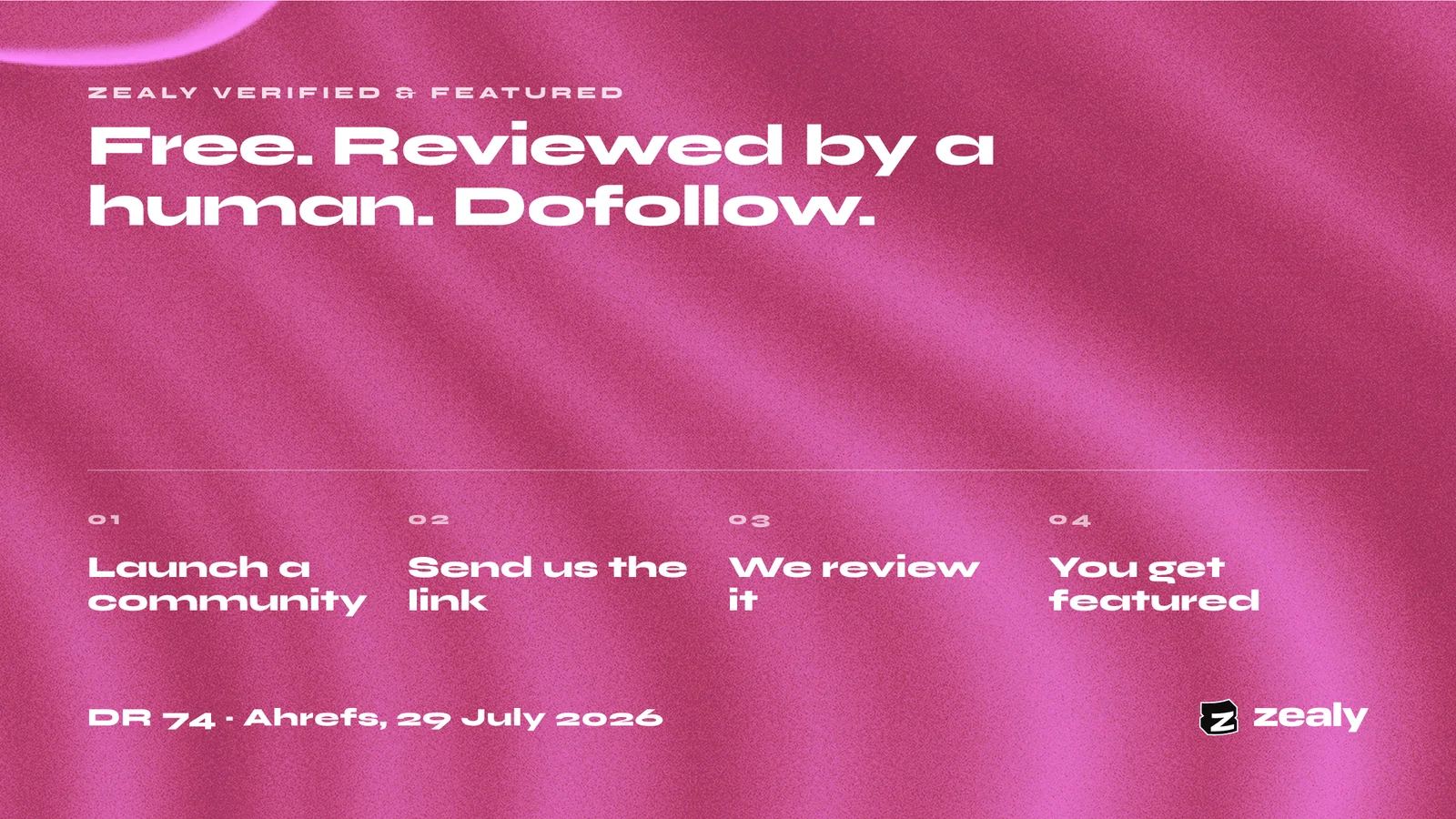
Launch a community on Zealy, then message our support team with the community URL. We pull your description, website and socials from the community itself, someone on our team reviews it, and if your project is real and your community is genuinely active, we feature you in Zealy editorial content — with a standard dofollow link to your site.
It costs nothing. There is no paid tier that buys the link, because a link you can buy is one Google expects to be marked sponsored.
zealy.io scored DR 74 when we queried the Ahrefs API on 29 July 2026. Domain Rating is Ahrefs' own 0–100 estimate of backlink-profile strength — a useful shorthand for "is this domain worth a link from", not a Google ranking factor, and not something we or anyone else should promise results from.
Two honest caveats. Not every request qualifies — an empty questboard with three quests and no members isn't a story, and featuring it would make the whole thing worthless. And your community profile link is not this link: like every honest UGC platform, Zealy applies rel="ugc nofollow" to outbound links on community and member profiles. The dofollow link is the editorial feature, which is a different page written by a person.
How to get it: create a free community, run a real quest sprint so there's something to write about, then contact Zealy support with the link.
2. Grant & ecosystem pages
The highest-trust free dofollow links in crypto. Chain foundations, accelerators and grant programmes publish portfolio pages, and those pages usually link out properly. You're not asking for a link — you're joining a programme that happens to list its members.
How to get it: apply to grants and ecosystem programmes you genuinely qualify for. Funded and portfolio projects get a linked listing.
3. Guest posts on crypto blogs
Still the strongest lever if you can write. A contextual dofollow link inside a genuinely useful article on an established crypto blog is worth more than fifty directory entries. "Free" means you trade the article for the placement. The moment money moves, it needs rel="sponsored" and the SEO value goes to zero.
How to get it: pitch original, data-backed ideas to blogs that accept contributors. One natural link, in the body, where it helps the reader.
4. Qwoted and Featured — earn press by being a source
Worth updating your playbook here, because most guides are years out of date. HARO no longer works the way people remember. Cision rebranded it as Connectively, then discontinued Connectively on 9 December 2024. The live options now are Qwoted and Featured, which acquired the HARO brand in 2025 and runs it as a free newsletter for sources and journalists. Peter Shankman, HARO's founder, also runs Source of Sources.
A good quote can earn a dofollow link from a high-authority news domain, for free. It's unpredictable — you might answer thirty requests for two placements — but the two are excellent.
How to get it: sign up as a source, answer fast, keep quotes short and specific, and include your title and site.
5. Web3 & dApp directories
DappRadar, DappList, Alchemy's dapp directory, CoinMarketCap DexScan, Cryptorank. Some pass dofollow, all provide topical relevance. Submit to the handful that are genuinely relevant to your chain and category, then stop — mass directory submission is a recognisable spam pattern.
How to get it: submit with a real description, category, contract address and official links.
6. CoinGecko
One of the most-trafficked and trusted domains in crypto. Outbound links are usually nofollow, so treat it as a trust and referral asset rather than a ranking one. It's still table stakes.
How to get it: submit through CoinGecko's request form with contract addresses and official links, then keep the listing current.
7. CoinMarketCap
Same role as CoinGecko, claimed in parallel. Being on both is what users and search engines expect of a real token project.
How to get it: use the listing request form, plus DexScan for on-chain projects. Verify ownership so you control your official links.
8. GitHub
A public organisation is expected of any legitimate crypto project. Links are nofollow, but GitHub is crawled heavily and an active repo is the credibility signal that makes editors take your pitch seriously.
How to get it: publish your contracts or SDK, and add your website to the org profile and README.
9. Mirror.xyz
The default publishing platform for Web3 writers and DAOs. Good home for launch posts, tokenomics explainers and governance writing.
How to get it: publish long-form posts and link to your canonical pages.
10. Podcasts, AMAs & interviews
Show notes almost always link to guests, and interviews generate quotes other people cite. Slower than it looks — expect a month between pitch and publication.
How to get it: pitch yourself with a specific, timely angle, and ask that the show notes link to your site.
11. Product Hunt & BetaList
A launch creates a concentrated spike that newsletters and journalists pick up. The listing itself is nofollow; the coverage it triggers is where the dofollow links come from.
How to get it: prepare assets, line up supporters, launch mid-week, and stay in the comments all day.
12. Crunchbase
Establishes your project as a real entity and feeds knowledge panels. Nofollow, but useful for disambiguation.
How to get it: create a company profile with funding, team and your official website.
13. Medium & crypto publications
Reach and syndication, not ranking signal. Set a canonical tag pointing at the original on your own domain so you don't compete with yourself.
How to get it: publish, then pitch crypto publications that accept contributors.
14. Reddit
r/CryptoCurrency, r/ethdev, r/defi and chain-specific subs send real referral traffic and surface in Google. Nofollow, heavily moderated, and unforgiving of self-promotion.
How to get it: contribute genuinely first, share resources only where the rules allow.
15. Quora & crypto Stack Exchanges
Well-ranked answers on Quora, Ethereum Stack Exchange and Bitcoin Stack Exchange keep sending qualified visitors for years.
How to get it: find questions your project genuinely answers and write the best answer on the page.
What gets you penalised
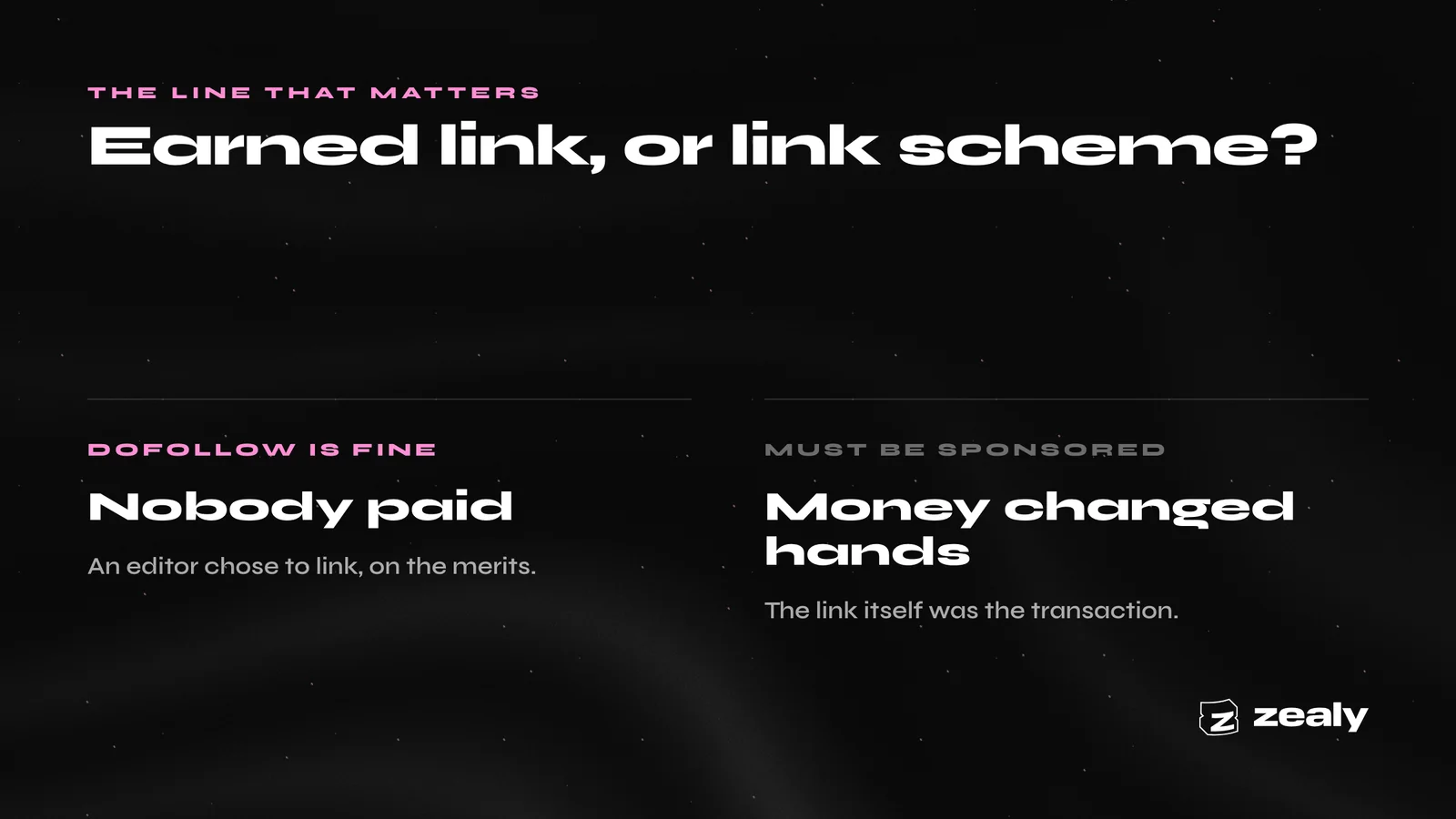
The line isn't how good the link looks. It's whether money or reciprocity bought the ranking signal. Google's link spam policy names advertorials and "paid guest posts" specifically, alongside "excessive link exchanges" and partner pages built only for cross-linking.
Practical version: if you paid for it — in cash, tokens, or product — it needs rel="sponsored". If an editor chose to link because your project was worth covering, it's dofollow and you're fine.
You can see the rule applied on this blog: every operator link in our ranking of the best crypto gambling sites carries rel="nofollow sponsored", because money moves on those clicks. Run the inspection test from earlier in this article on that page and the markup is right there.
Your first 90 days
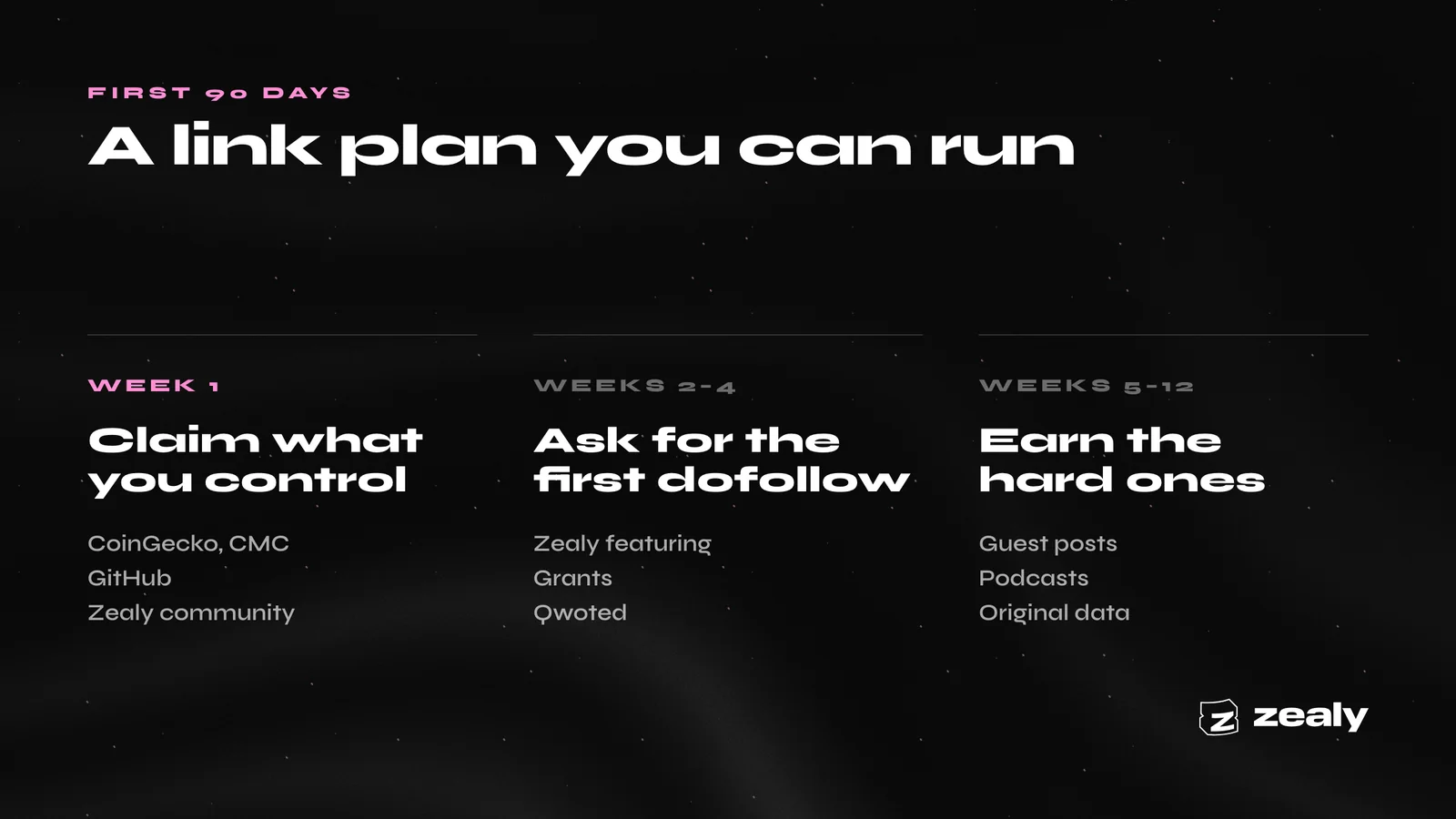
Front-load the links you control, then spend the slow weeks on the ones you have to earn. Expect weeks, not days: Google has to crawl the linking page before anything moves. Referral traffic, on the other hand, arrives the day the link goes live.
FAQs
Start with something worth linking to
Every durable link profile is downstream of the same thing: people who care about your project. Listings put you on the map. The links that compound come from something real happening that partners, press and users want to write about.
That's the honest reason our own offer is structured the way it is. We can't feature a community that doesn't exist yet — but if you build one, we'll link to it properly.
Launch your free Zealy community, run a sprint, then send support the link.